UNDERSTANDING COFFEE · MICROBES & FERMENTATION
A better way to understand coffee fermentation is as a changing ecosystem.
When I first started trying to understand fermentation, the obvious mental model was simple: some bacteria and yeasts must be useful, others must be harmful, and good processing means encouraging the good ones.
There is a little truth in that. Some microorganisms and some of the compounds they produce are certainly associated with desirable outcomes, while others can contribute to spoilage, defects or safety problems.
But the good-versus-bad model quickly breaks down.
THE SIMPLE ANSWER
Think ecology, not heroes and villains
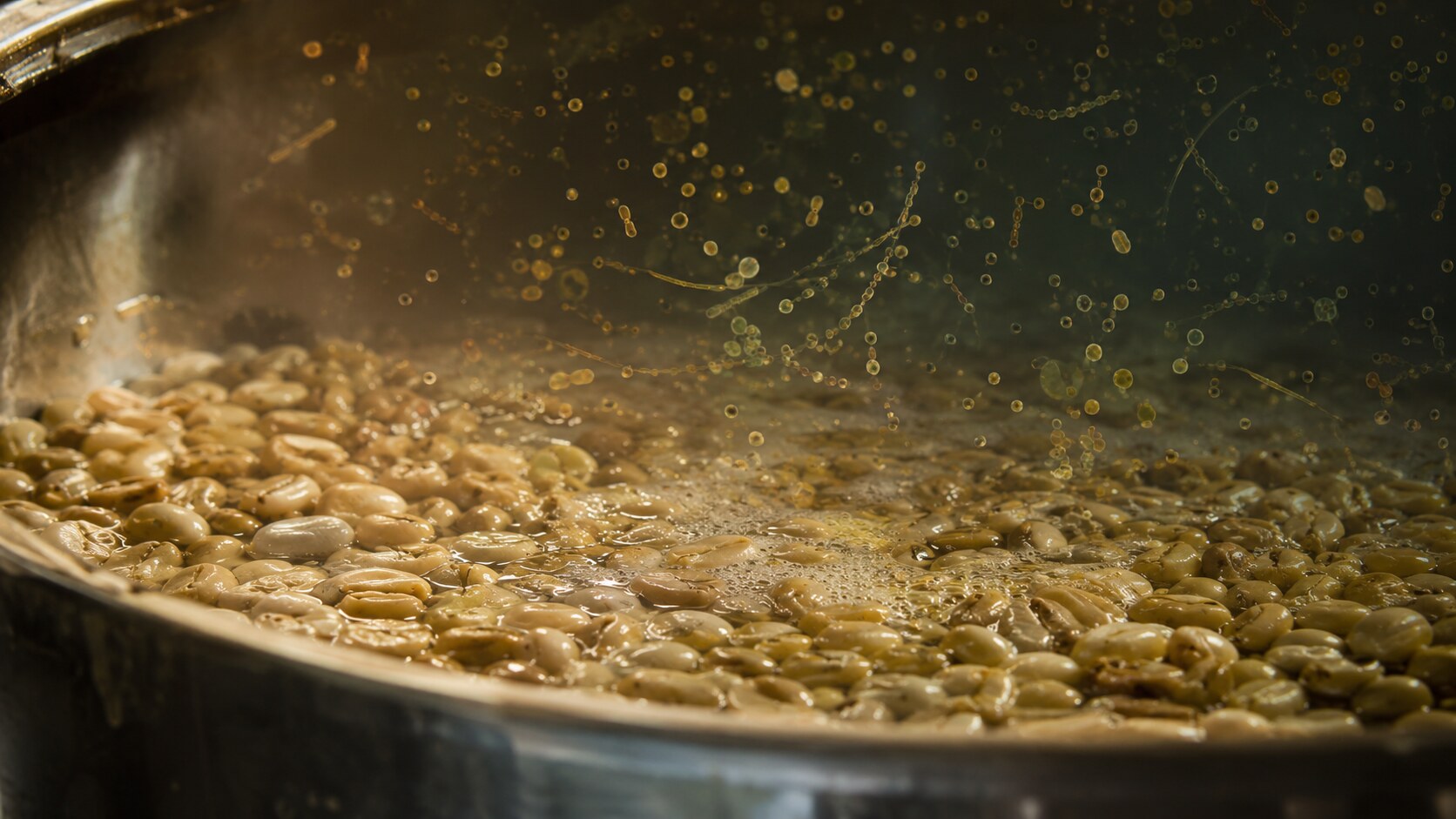
A coffee fermentation contains populations of yeasts, bacteria and sometimes filamentous fungi competing for food and space while responding to a changing environment.
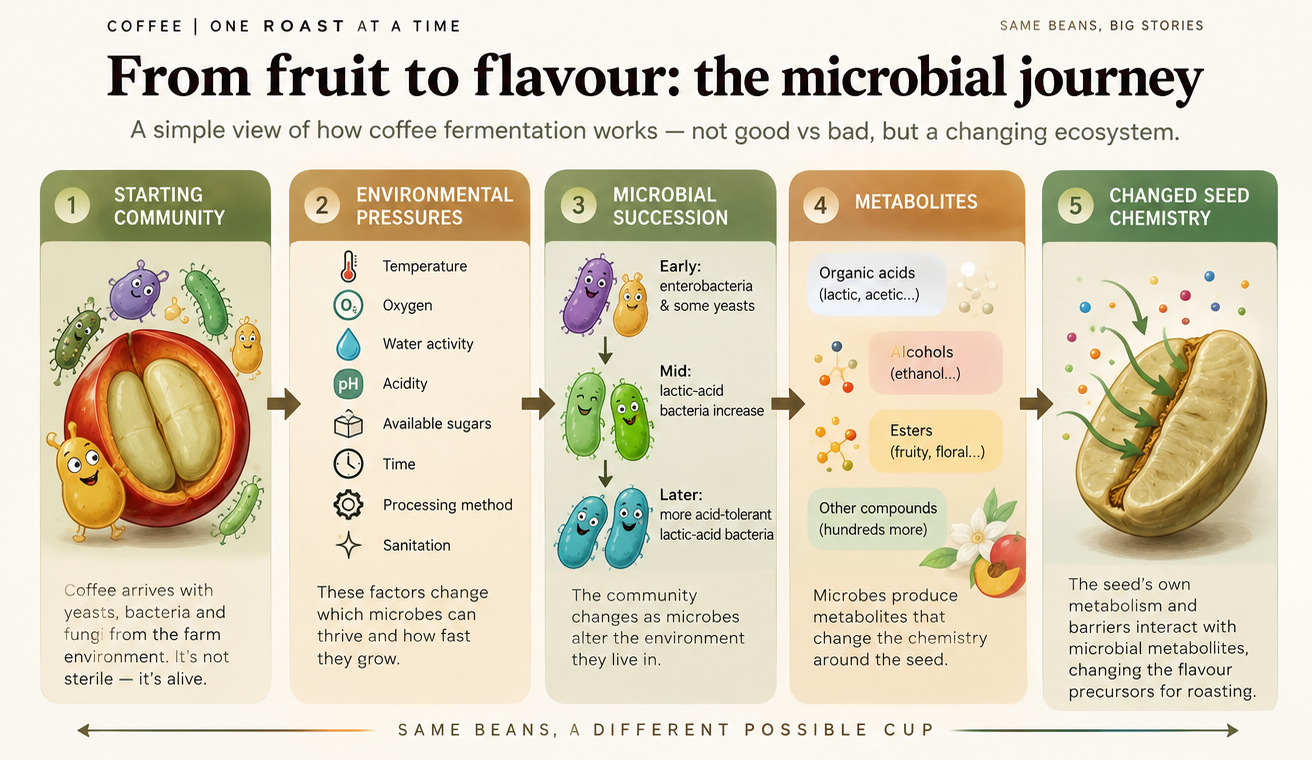
The organisms present at the beginning do not necessarily dominate later. As microbes consume sugars and produce acids, alcohols, carbon dioxide and other metabolites, they alter the conditions around them. That can make the environment less suitable for one population and more suitable for another.
This changing sequence of microbial communities is called succession.
A coffee cherry already has an ecosystem
Coffee does not enter processing as a sterile raw material.
Microorganisms can be associated with the fruit and its surroundings, and additional organisms can come from the farm environment, water, equipment, drying surfaces and handling. Studies of coffee processing have repeatedly found communities containing bacteria, yeasts and fungi, with their composition varying according to processing method, location and time. [1][2]
A 2017 study following Arabica coffee through wet and dry processing found distinctly different microbial communities under the two processing systems. During wet processing, lactic-acid bacteria were prominent alongside yeasts including Pichia and Starmerella. [2]
Natural processing can support a different and often more diverse community because the intact fruit remains around the seed for much longer. Earlier work on natural coffee found that the balance of bacteria, yeasts and filamentous fungi changed as fermentation and drying progressed. [3]
The winners change because the environment changes
This is the part that made fermentation click for me.
Imagine the fermenting coffee at hour zero. There is plenty of sugar, a particular amount of oxygen, a starting temperature and a starting pH. Several organisms may be capable of growing there.
Those organisms then begin changing their own world.
They consume nutrients. They produce acids and alcohols. Oxygen availability changes. Carbon dioxide accumulates. The pH can fall. Plant material is broken down. Temperature can change.
The organism that is well suited to the first few hours may therefore be poorly suited to the environment that exists a day later.
A 2020 shotgun-metagenomics study of wet coffee fermentation in Ecuador identified more than 150 microbial species and described three successive phases: an early phase containing enterobacteria, acetic-acid bacteria and some yeasts; a second phase increasingly dominated by lactic-acid bacteria; and a later phase dominated by more acid-tolerant lactic-acid bacteria. [4]
Recent research continues to observe the same broad ecological behaviour. A 2026 study of self-induced anaerobic fermentation found significant restructuring of bacterial and fungal communities during fermentation and showed that time, temperature, processing conditions and starter-culture use influenced the microbiome. [5]
So “survival of the fittest” is useful shorthand, provided we add one important qualification:
the fittest organism is the one best suited to the conditions at that particular moment.
WORKING MODEL
The environment selects the community
Coffee + existing microbiota
↓
temperature · oxygen · water · sugars · pH · time
↓
some organisms grow faster than others
↓
microbial metabolism changes the environment
↓
a different community becomes better adapted
↓
different metabolites and chemical conditions
So are there bad microbes?
There certainly can be undesirable microbial activity. But even here, it is usually more useful to talk about organisms, conditions and metabolites together rather than labelling an entire microbial group as bad.
For example, prolonged or poorly managed fermentation can favour compounds associated with defects. Butyric and propionic acids have been associated with undesirable fermented or rancid characteristics, while excessive acetic acid can also become detrimental. Filamentous fungi require particular attention because some species can contribute off-flavours or present mycotoxin risks. [3][6]
At the same time, simply extending fermentation does not automatically mean ruining the coffee.
In a detailed 2019 study of wet processing, extended fermentation under conditions favouring lactic-acid bacteria did not produce the expected defects. The authors instead found desirable changes in flavour precursors and sensory characteristics. When the fermentation environment was changed, however, different organisms and metabolites associated with off-flavours could emerge. [7]
That is a useful warning against simple rules such as:
long fermentation = bad
or
this bacterial genus = good.
Context matters.
Yeasts are a good example
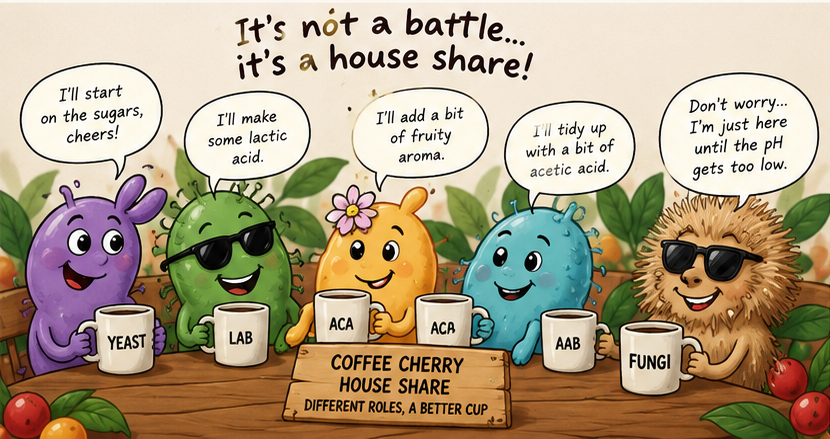
Yeasts are often associated with desirable coffee fermentation because they can produce alcohols, esters and other compounds relevant to aroma and flavour development.
One particularly interesting experiment compared normal spontaneous wet fermentation with a fermentation in which yeast activity was deliberately suppressed. Coffee fermented with active yeasts contained substantially more ethanol, acetaldehyde, ethyl acetate and isoamyl alcohol, and the resulting coffees received higher sensory scores in that particular experiment. [8]
That is strong evidence that yeast activity can matter.
It does not, however, establish a rule that “more yeast is always better”, or that one yeast species will create the same flavour on every farm and every coffee.
The substrate, strain, temperature, oxygen, competing organisms, fermentation duration, drying and the chemistry of the coffee itself all remain part of the system.
The producer is shaping an ecosystem
This is where fermentation stops looking like microbial roulette.
A producer may not be controlling every organism, but processing decisions alter the environment in which those organisms compete.
Important variables include:
- whole cherry or depulped coffee
- oxygen availability and vessel design
- submerged or relatively dry conditions
- temperature
- fermentation time
- water quality and quantity
- initial sugar and nutrient availability
- sanitation and equipment
- agitation or mixing
- the use — or not — of a starter culture
A 2023 review of coffee-fermentation research concluded that fermentation protocols influence microbial development and sensory outcome, but also stressed that there is no single protocol capable of producing one predictable sensory result across every environment. [1]
That leads to the most useful definition I have found for controlled fermentation:
Controlled fermentation means controlling the odds, not controlling every microbe.
And what does this eventually have to do with flavour?
The microorganisms are not simply adding ready-made tasting notes to a coffee bean.
Their metabolism changes the chemical environment around the seed. They consume sugars and other substrates and produce organic acids, alcohols, esters and many other compounds. At the same time, the living coffee seed has its own metabolism.
Research following coffee from fermentation through green bean and sensory analysis shows an interaction between microbial activity and endogenous bean metabolism that changes the flavour-precursor profile available later during roasting. [7]
That is why a claim such as:
“this yeast creates strawberry flavour”
should make us cautious.
A more defensible chain is:
microbial ecology → metabolites and changed bean chemistry → drying → roasting chemistry → cup.
There are a lot of steps between the microbe and the flavour we finally perceive.
WE KNOW
Coffee fermentation communities change over time.
Multiple culture-based and sequencing studies have directly observed microbial succession, and processing conditions influence which communities emerge.
EVIDENCE SUGGESTS
The resulting ecology can influence coffee chemistry and sensory outcome.
Microbial metabolites, altered green-bean chemistry and endogenous seed metabolism all appear to participate.
OPEN QUESTION
How predictable can flavour really become?
Results from one strain, cultivar, farm or fermentation protocol cannot yet be assumed to transfer cleanly to another.
THE TAKEAWAY
Fermentation is ecological selection
Instead of imagining a tank full of good microbes fighting bad microbes, imagine a succession of communities responding to an environment that is continually changing — partly because the microbes themselves are changing it.
The producer influences that environment. The environment selects which organisms prosper. Those organisms alter the chemistry. And that chemistry becomes part of the starting material eventually handed to the roaster.
That model is less tidy than “good bacteria versus bad bacteria”.
It is also much closer to what the research actually shows.
CONTINUE EXPLORING
Return to the Microbes & Fermentation hub, or see how different post-harvest choices alter the environment in the Processing Explorer.
Evidence behind this article
[1] Ferreira, L.J.C., Gomes, M.S., Oliveira, L.M. & Santos, L.D. (2023). Coffee fermentation process: A review. Food Research International, 169, 112793. DOI: 10.1016/j.foodres.2023.112793.
[2] De Bruyn, F. et al. (2017). Exploring the Impacts of Postharvest Processing on the Microbiota and Metabolite Profiles during Green Coffee Bean Production. Applied and Environmental Microbiology, 83, e02398-16. DOI: 10.1128/AEM.02398-16.
[3] Silva, C.F., Batista, L.R., Abreu, L.M., Dias, E.S. & Schwan, R.F. (2008). Succession of bacterial and fungal communities during natural coffee (Coffea arabica) fermentation. Food Microbiology, 25(8), 951–957. DOI: 10.1016/j.fm.2008.07.003.
[4] Pothakos, V. et al. (2020). Temporal shotgun metagenomics of an Ecuadorian coffee fermentation process highlights the predominance of lactic acid bacteria. Current Research in Biotechnology, 2, 1–15. DOI: 10.1016/j.crbiot.2020.02.001.
[5] Silva, L.C.F. et al. (2026). Microbial community dynamics during Coffea arabica cv. Arara fermentation and their relationship with specialty coffee quality. Scientific Reports, 16, 21933. DOI: 10.1038/s41598-026-44864-z.
[6] Waters, D.M., Arendt, E.K. & Moroni, A.V. (2017). Overview on the mechanisms of coffee germination and fermentation and their significance for coffee and coffee beverage quality. Critical Reviews in Food Science and Nutrition, 57(2), 259–274. DOI: 10.1080/10408398.2014.902804.
[7] Zhang, S.J. et al. (2019). Following Coffee Production from Cherries to Cup: Microbiological and Metabolomic Analysis of Wet Processing of Coffea arabica. Applied and Environmental Microbiology, 85, e02635-18. DOI: 10.1128/AEM.02635-18.
[8] Elhalis, H., Cox, J., Frank, D. & Zhao, J. (2020). The crucial role of yeasts in the wet fermentation of coffee beans and quality. International Journal of Food Microbiology, 333, 108796. DOI: 10.1016/j.ijfoodmicro.2020.108796.