Understanding Coffee — Lesson 3
Processing: from harvested fruit to green coffee
Processing is the sequence of decisions that turns a harvested coffee fruit into a stable seed ready for storage, export and roasting.
The useful question is not simply “washed or natural?”. It is what happened to the fruit, mucilage, fermentation environment, water and drying — and which parts the label still leaves unexplained.
FOUR THINGS TO WATCH
Most processing differences come back to a few physical decisions
The labels can multiply quickly. The underlying questions are much simpler.
Fruit removal
Does the cherry dry whole, get pulped first, or have most fruit and mucilage removed before drying?
Fermentation & mucilage
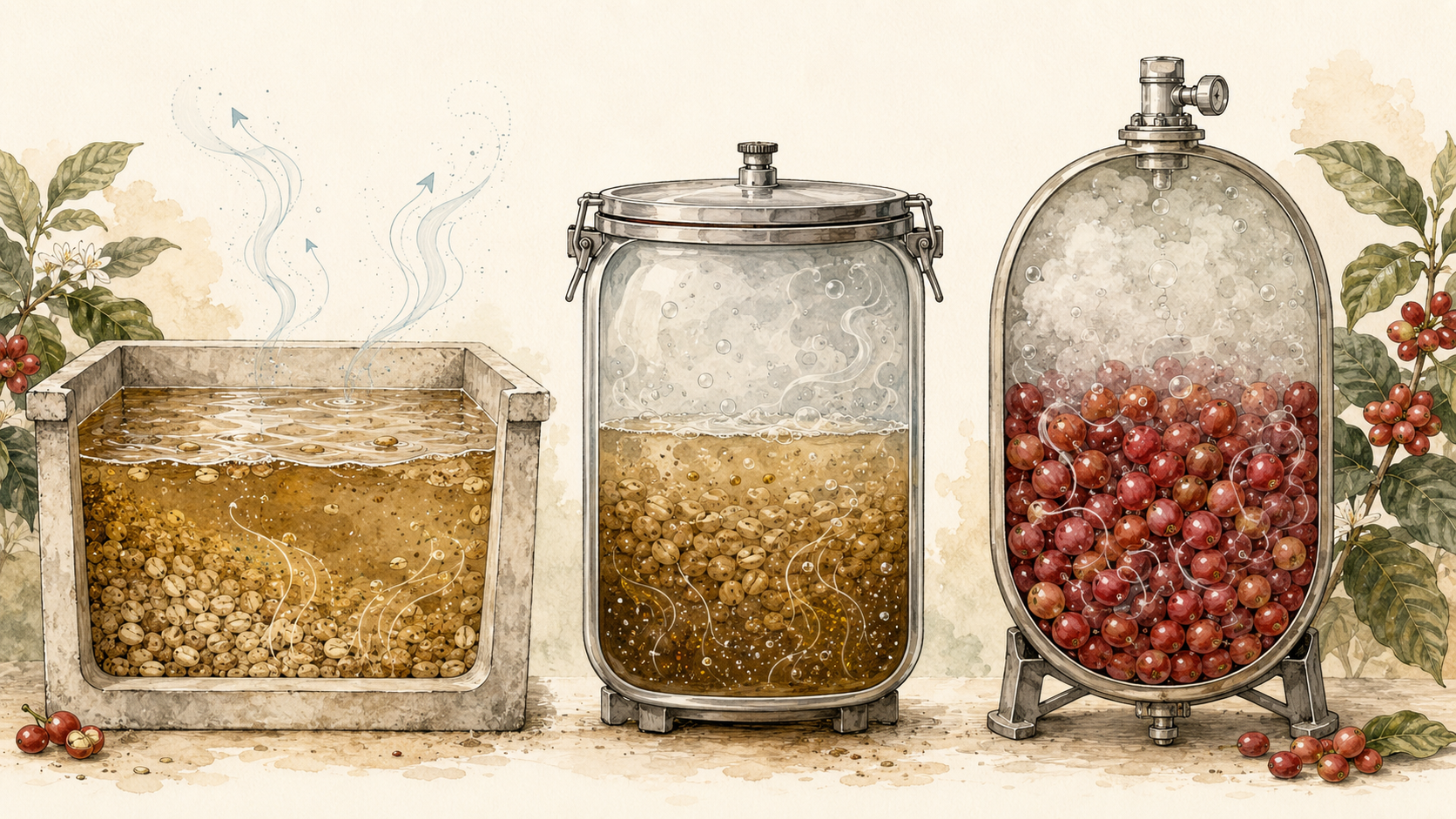
Microbes are active in many processing paths. The useful details are the substrate, oxygen, water, time, temperature and whether cultures or other inputs were added.
Drying
Every path eventually has to remove water safely and evenly. Drying is a major quality and stability stage, not an afterthought.
Hulling & stability
Protective layers are removed at different points, then the green coffee must remain physically and chemically stable through storage and transport.
THE THREE ANCHOR PATHS
Start with what happens to the fruit before drying
These broad pathways are more durable than fashionable processing names. Real producers add many variations around them.
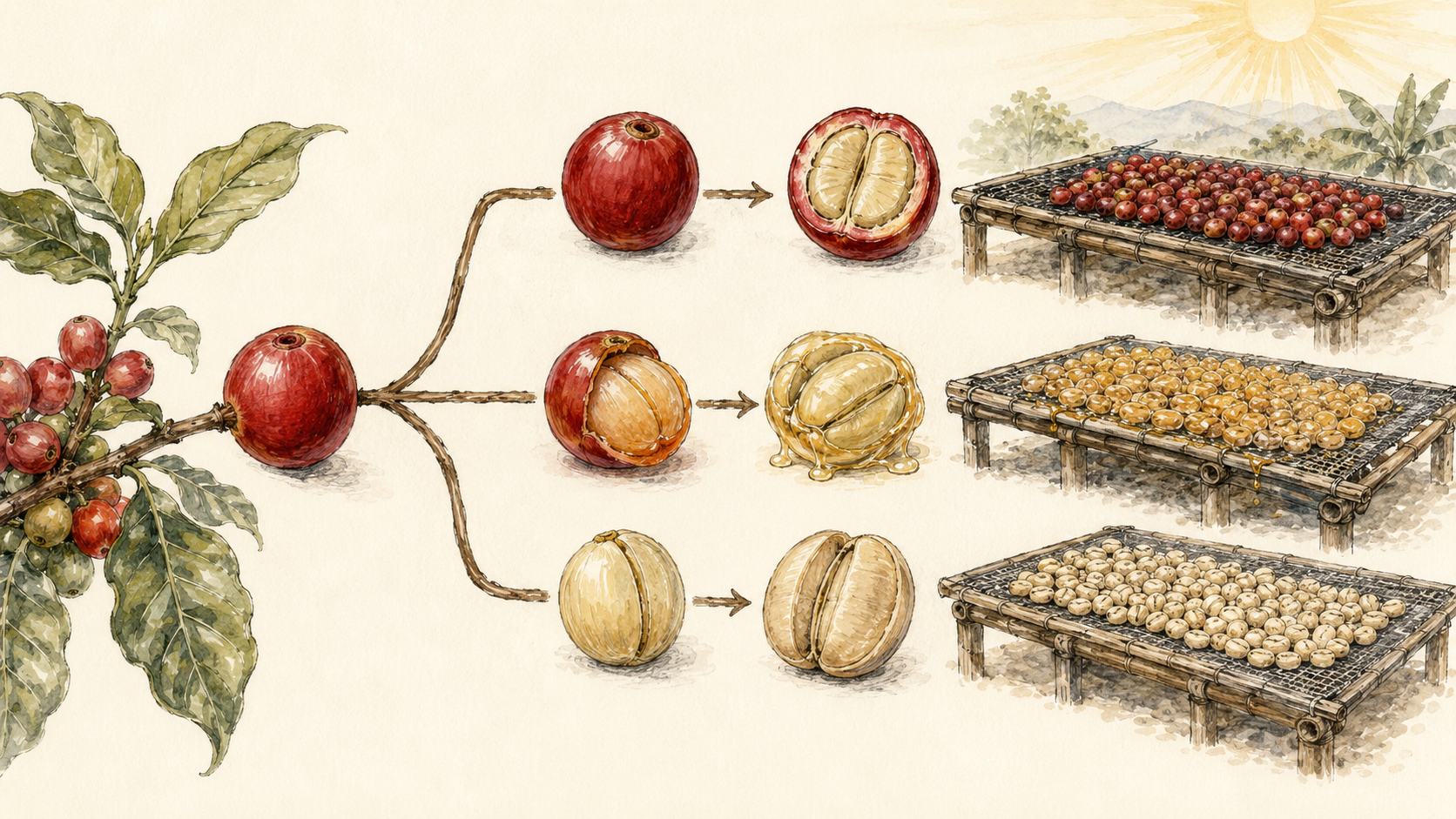
Natural / dry
The whole cherry dries with the fruit and mucilage still around the seed. Sorting, layer depth, turning, airflow, weather and drying time all matter.
Honey / pulped natural
The skin is removed before drying while some mucilage remains. Colour labels such as yellow, red and black are useful producer terms, not universal measurements.
Washed / wet
Fruit is removed before drying. Remaining mucilage may be broken down through fermentation and washing, or removed mechanically in some systems.
A LABEL CAN HELP
It tells you where to ask next
“Natural”, “washed” and “honey” tell you something meaningful about the physical path. Terms such as anaerobic, extended or inoculated tell you about a condition or intervention layered onto that path.
A LABEL IS NOT A RECIPE
The missing details still matter
Cherry ripeness, sorting, tank conditions, time, temperature, drying, storage and producer choices can differ enormously beneath the same headline label.
Choose a way into the field guide
Use the tool to follow the physical journey, decode bag language, or compare two labels without turning either one into a flavour guarantee.
Follow the journey
See where fruit removal, fermentation, drying and hulling differ.
Decode a label
Translate process language into a technical interpretation and better follow-up questions.
Compare methods
See where two labels overlap, diverge and leave important details unresolved.
Go deeper into fermentation
Once the physical process is clear, continue into the yeasts, bacteria and changing fermentation environment.
Processing journey map
From ripe cherry to stable green coffee. Start with the physical path — whole cherry, pulped with mucilage, or fruit removed before drying — then use the other labels as added conditions or interventions. Select a record below to see where it changes the journey, what it may suggest, and what it still leaves unanswered.
Decode a coffee label
Type what's on your coffee bag. The decoder separates origin, variety, physical process, fermentation language and decaf treatment so one headline term does not quietly become the whole story.
Compare two processes
Select any two processing labels to compare the physical mechanics, how informative each label really is, and what questions remain. A stable process family and a fermentation modifier are not necessarily equivalent categories — the comparison should make that visible.
Processing myths worth knowing
Some processing shorthand has become so common that it shapes expectations before the coffee is even tasted. These are practical corrections — not coffee snobbery. They are here because inaccurate expectations make it harder to assess what is actually in the cup.
Processing labels are the start of the conversation
A label rarely tells you the full recipe. Cherry condition, fermentation environment, drying, storage and decaffeination are separate decisions, and terms vary between producers and regions.
Editorial approach: the foundational natural, honey, washed, mechanically demucilaged and wet-hulled mechanics have been checked against academic/technical reviews. Anaerobic and inoculated fermentation have also been tightened against current fermentation literature. Less-standardised experimental labels and decaf claims remain visibly cautious while their specific source audit continues. Cup tendencies are clues, never promises.
KEEP GOING
← Previous: Species & varieties
Return to the plant identity and relationship map behind names such as Bourbon, Catuai and Java.
Next: Microbes & fermentation →
Now follow the living microbial succession that can reshape the environment around the seed during processing.