While researching the move from my Gene Café CBR-301 to the Kaleido M2 Pro, I kept coming across the same word:
thermodynamics.
I knew, broadly speaking, that it had something to do with heat and energy.
Beyond that, not much.
My maths education was firmly at the practical end of the scale, so equations full of letters, Greek symbols and fractions tend to have the same effect on me as someone suddenly switching a conversation into Latin.
But the more I looked at the M2, the more obvious it became that understanding at least a little of what is happening with heat might actually help me understand the roaster.
The Gene Café had taught me a lot about observation: total roast time, weight loss, colour, first crack, machine state and repeatability.
The Kaleido is going to give me considerably more control.
I can adjust heater power, airflow and drum speed. I can watch bean temperature and environmental temperature in Artisan. I can follow Rate of Rise. And, through CoffeePI and the Green Bean Ledger work I am developing alongside it, I should eventually be able to record quite a lot about what the machine is actually doing.
That raises an obvious question:
What exactly are those controls changing?
This article is my attempt to answer that in very simple terms.
I do not pretend to understand the physics properly, and this is certainly not intended as an academic explanation of thermodynamics. I used ChatGPT to help me work through the concepts and translate them into something I could understand.
As with anything AI-assisted, treat this as a learning aid rather than an authority. Check things for yourself, compare them with reputable sources, and do not rely on anything here simply because it sounds convincing.
With that said, the following model finally started to make sense to me.
A coffee bean has a heat budget
The equation that started all this was:
That looked fairly terrifying at first.
But translated into normal English, it is really saying something much simpler:
How quickly the bean gets hotter depends on the heat going into it, minus the energy being used elsewhere.
Or even more simply:
Bean heating = hot air + radiant heat + contact heat − energy used evaporating water + heat from chemical reactions.
That I can work with.
Heat can reach the coffee in several ways
On the M2, there are three main ways energy can reach the beans.
Convection — hot moving air
Convection is heat carried by moving air.
The M2 uses a fan to move heated air through and around the coffee.
The faster and hotter that air is, the more effectively it can transfer energy to the beans.
This immediately changes how I think about airflow.
The fan is not simply there to remove smoke and chaff.
It is part of the heat-transfer system.
Changing airflow may change how much heat reaches the coffee, how quickly moisture and smoke leave the roasting chamber, and what the environmental temperature probe sees.
That means a higher fan setting does not automatically mean either:
more heat
or:
more cooling.
It depends on what the additional airflow is doing inside that particular roaster at that particular point in the roast.
That is something I am looking forward to testing.
Radiation — heat coming directly from the heaters
My M2 Pro is expected to have two 800 W carbon-fibre heating elements mounted above the roasting chamber, giving around 1600 W of nominal heating capacity.
Those heaters emit infrared radiation.
Radiant heat is the kind of heat you can feel standing near a fire even when you are not touching it.
The M2 uses a perforated or mesh-style drum, which means the beans can have more direct exposure to the heating elements than they would inside a completely solid drum.
That makes radiant energy an important part of how this particular roaster works.
It also means bean movement matters.
If the beans are constantly moving through the drum, their exposure to that radiation is constantly changing.
That brings drum speed into the thermal picture too.
Conduction — heat through contact
Conduction is simpler.
It is heat transferred because two things touch.
A bean touches the hot drum.
A bean touches another hot bean.
Heat moves between them.
The M2 may rely less heavily on drum-wall conduction than a traditional heavy commercial drum roaster, but it still happens.
So the beans are effectively receiving heat from several directions at once:
moving hot air, radiant heaters and physical contact.
Water complicates everything
This was one of the most useful things for me to understand.
Green coffee contains water.
Heating that water and turning it into vapour takes energy.
That means some of the energy entering the bean is not immediately being used to increase its temperature.
It is being used to remove water.
That is why evaporation appears with a minus sign in the equation.
Think about a wet towel on a radiator.
The radiator is supplying heat, but some of that energy is being used to evaporate the water rather than simply making the towel hotter.
Coffee is obviously considerably more complicated than a towel, but the principle helped me understand what is going on.
It also makes moisture content more interesting.
Two coffees may respond differently to the same roast settings because they are not necessarily carrying the same amount of water or behaving internally in the same way.
And importantly, the point we commonly call “dry end” does not mean the bean suddenly contains no water.
It is simply a useful roasting milestone.
Water continues to move and leave the coffee later into the roast.
The bean is not one temperature
Another simple idea that I had never really stopped to think about:
When Artisan tells me the bean temperature is 180°C, that does not mean every part of every bean is exactly 180°C.
Heat must move from the outside of the bean towards the inside.
Water and vapour are moving in the opposite direction.
The outside can therefore be hotter than the centre.
That matters because it explains why simply throwing more heat at the coffee is not necessarily better.
You can heat the surface faster than heat can move through the bean.
In extreme cases, the outside can be over-roasted while the inside has not developed in the same way.
So roasting is partly about controlling how quickly energy arrives.
Not just how much.
First crack is not an on/off switch
I had also carried around a very simplified mental picture of first crack.
Something along the lines of:
The beans absorb heat until first crack, then suddenly become exothermic and start generating heat themselves.
It appears reality is much messier than that.
Chemical reactions that absorb and release energy overlap throughout the roast.
Water continues leaving.
Gases build inside the bean.
Pressure increases.
The physical structure of the coffee changes.
Eventually that internal pressure and structural change contribute to what we hear as first crack.
So first crack is extremely useful as an observable event, but it is not a magical point where the laws of the roast suddenly change.
That is another reason I want to avoid treating every movement in Rate of Rise around first crack as something that requires an immediate reaction.
Rate of Rise is the result, not the control
This was probably the biggest light-bulb moment for me.
Rate of Rise — RoR — tells us how quickly the measured bean temperature is changing.
If the beans are warming quickly, RoR is high.
If they are warming more slowly, RoR is lower.
But I cannot directly control RoR.
I control things such as:
- heater power
- airflow
- drum speed
Those controls change the amount and distribution of heat.
The bean responds.
The temperature probe measures some part of that response.
Artisan then calculates Rate of Rise from that temperature information.
So perhaps the most useful way for me to think about RoR is:
RoR is evidence of what the bean and roaster are doing, not a knob I am directly controlling.
That sounds obvious once written down.
It was not obvious to me before.
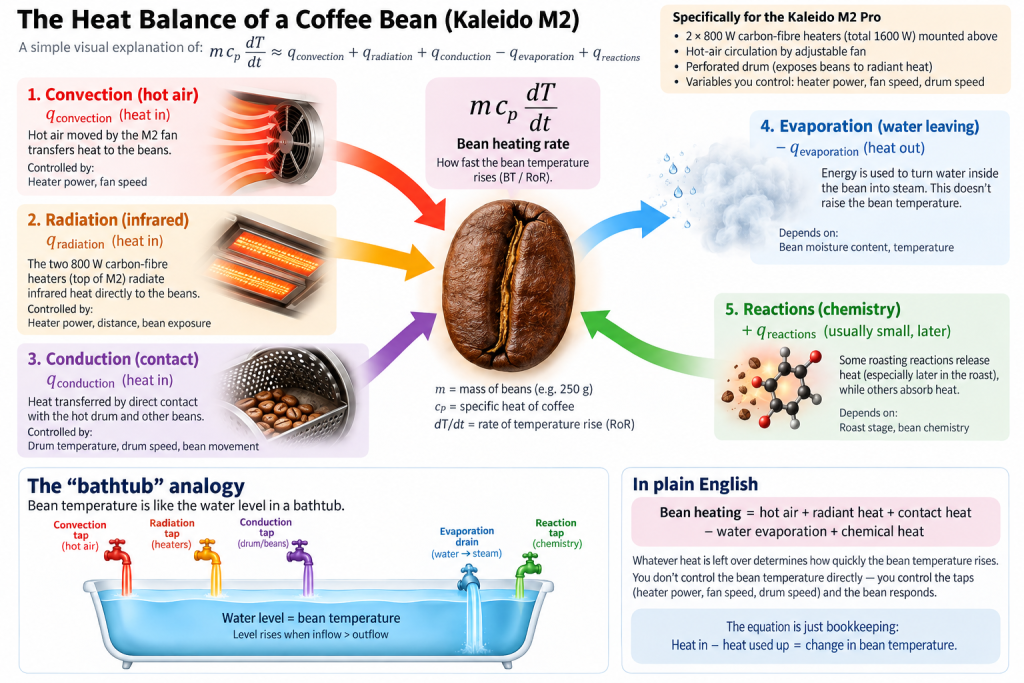
The bathtub analogy
The easiest visual model I have found is a bathtub.
Imagine the water level in the bath represents bean temperature.
Three taps are filling it:
Convection
Hot moving air.
Radiation
Energy from the heating elements.
Conduction
Contact with the drum and other beans.
There is also a drain:
Evaporation
Energy being used to turn water into vapour.
And later in the roast, chemical reactions may add or consume some additional energy.
If more energy is entering than leaving or being consumed, the water level rises.
The faster the imbalance, the faster the level rises.
That is essentially what the intimidating equation is describing.
The equation is bookkeeping.
Heat in.
Heat used.
Resulting change in bean temperature.
Why this matters on the Kaleido M2
The Gene Café CBR-301 gave me relatively limited control.
It behaved much more like a bounded hot-air roasting system where total roast time, starting state, temperature milestones, weight loss and cup result became more useful than trying to control every movement in a graph.
The M2 should be very different.
It gives me separate control over:
- heater power
- fan speed
- drum speed
That means I can start asking more interesting questions.
What happens if I reduce heater power at this point?
How long before environmental temperature responds?
How long before bean temperature responds?
What happens if I increase airflow?
Does Rate of Rise increase because heat transfer improves?
Or decrease because more cooler air is moving through the machine?
Does drum speed change how evenly the beans receive radiant heat?
Does a warm roaster behave differently from a cold one even when the displayed temperatures look similar?
Those are thermodynamic questions, even if I never calculate a single equation.
And that, for me, is where understanding a little of this becomes useful.
The curve is evidence, not the target
One thing I would like to avoid as I move into Artisan and the M2 is becoming obsessed with drawing a perfect roast curve.
It would be very easy to watch Rate of Rise and start chasing every little movement.
Instead, I want to understand why the curve is moving.
If RoR starts falling, perhaps the answer is not automatically more heater power.
Maybe the temperature difference between the roasting environment and the beans has become smaller.
Maybe airflow changed.
Maybe water is absorbing significant energy.
Maybe a heater adjustment made thirty seconds earlier is only now becoming visible.
Maybe the probe itself is lagging.
The graph is telling me something happened.
The interesting part is working out why.
What I actually need to remember
After all the equations, physics and terminology, I think my useful working model is remarkably simple.
A coffee bean is receiving energy from:
**hot air
- radiant heat
- contact heat**
Some energy is being consumed by:
water leaving the coffee
And the chemistry of roasting is also changing the energy balance.
The amount of coffee, the condition of the roaster, airflow, heater power, drum speed and the coffee itself all influence how quickly the bean responds.
I do not need to understand the underlying equations well enough to solve them.
I simply need to understand what they are trying to tell me.
And the bit that now makes sense is this:
I am not directly controlling bean temperature or Rate of Rise. I am controlling the things that influence how energy reaches the coffee. The roast curve shows me how the system responded.
That feels like a much better starting point for learning the Kaleido M2.
One Roast at a Time
None of this suddenly makes me an expert in coffee-roasting thermodynamics.
Quite the opposite.
It has mainly shown me how much is actually happening inside something as apparently simple as heating a few hundred grams of green coffee.
But I now understand enough to ask better questions.
And that is probably all I need at this stage.
Once the M2 arrives, the intention is not to immediately find the perfect roast profile.
It is to learn how the machine behaves.
Change one thing.
Watch what happens.
Record it.
Taste the coffee.
Then try again.
One roast at a time.