UNDERSTANDING COFFEE / FRUIT & SEED
What is a coffee bean?
Before coffee is green, roasted, ground or brewed, it is a seed growing inside a fruit.
Calling it a “bean” is convenient, but botanically coffee begins somewhere much more interesting: inside the cherry of a living Coffea plant. Understanding that fruit and seed gives us a better starting point for everything that follows — variety, processing, fermentation, drying and eventually roasting.
THE STARTING POINT
Coffee is a fruit before it is a drink
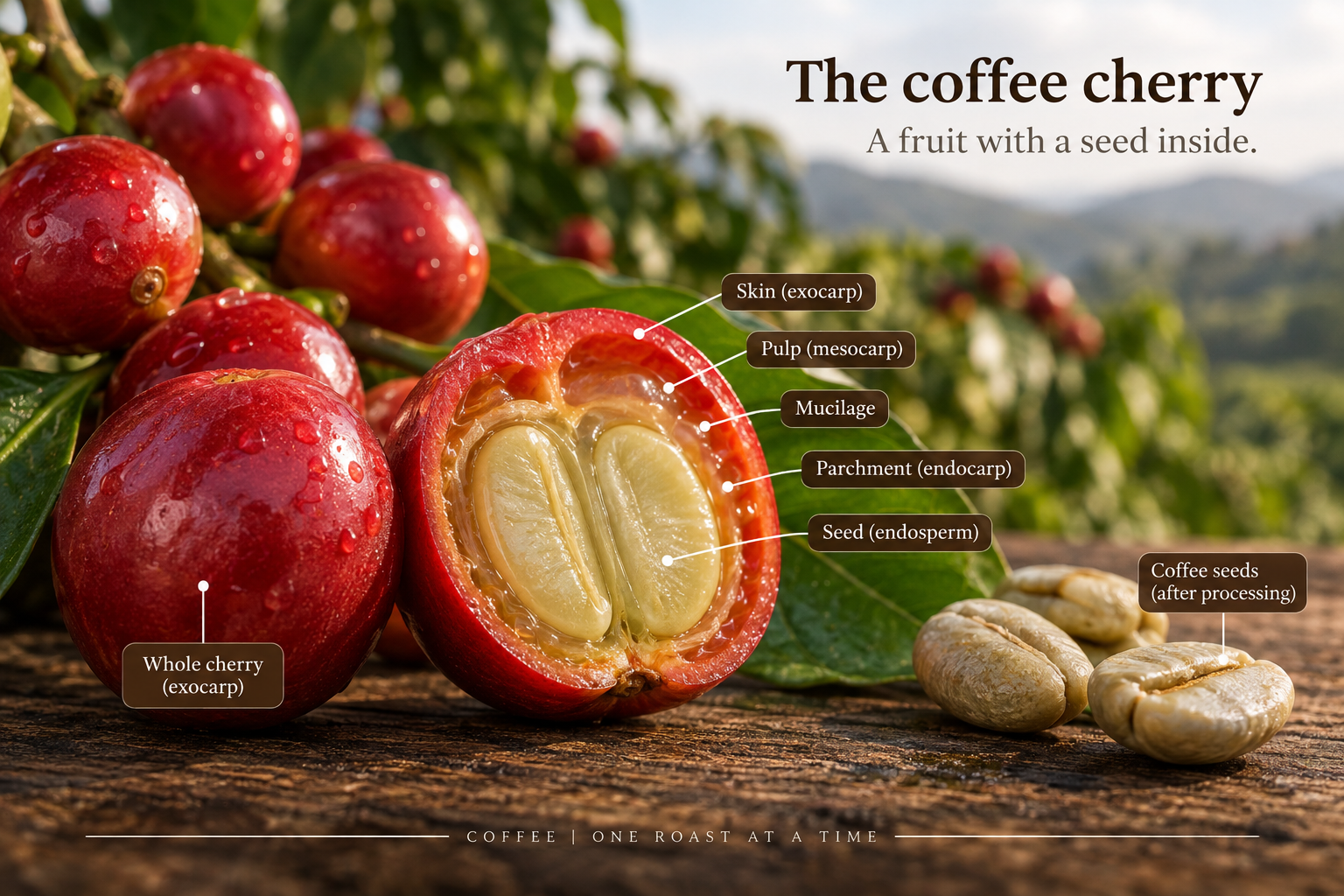
A coffee plant produces flowers, and fertilised flowers can develop into fruit. We usually call that fruit a coffee cherry.
When the cherry ripens, the outside may become red, yellow or occasionally another colour depending on the plant and variety. Inside are layers of fruit tissue surrounding the seeds that we eventually know as coffee beans.
The short version
Coffee plant → flower → coffee cherry → seed → processed green coffee → roasted coffee → cup.
Most of the coffee industry begins talking about the “bean” somewhere around the seed or green-coffee stage. Biologically, however, the story started much earlier.
INSIDE THE CHERRY
A seed protected by layers
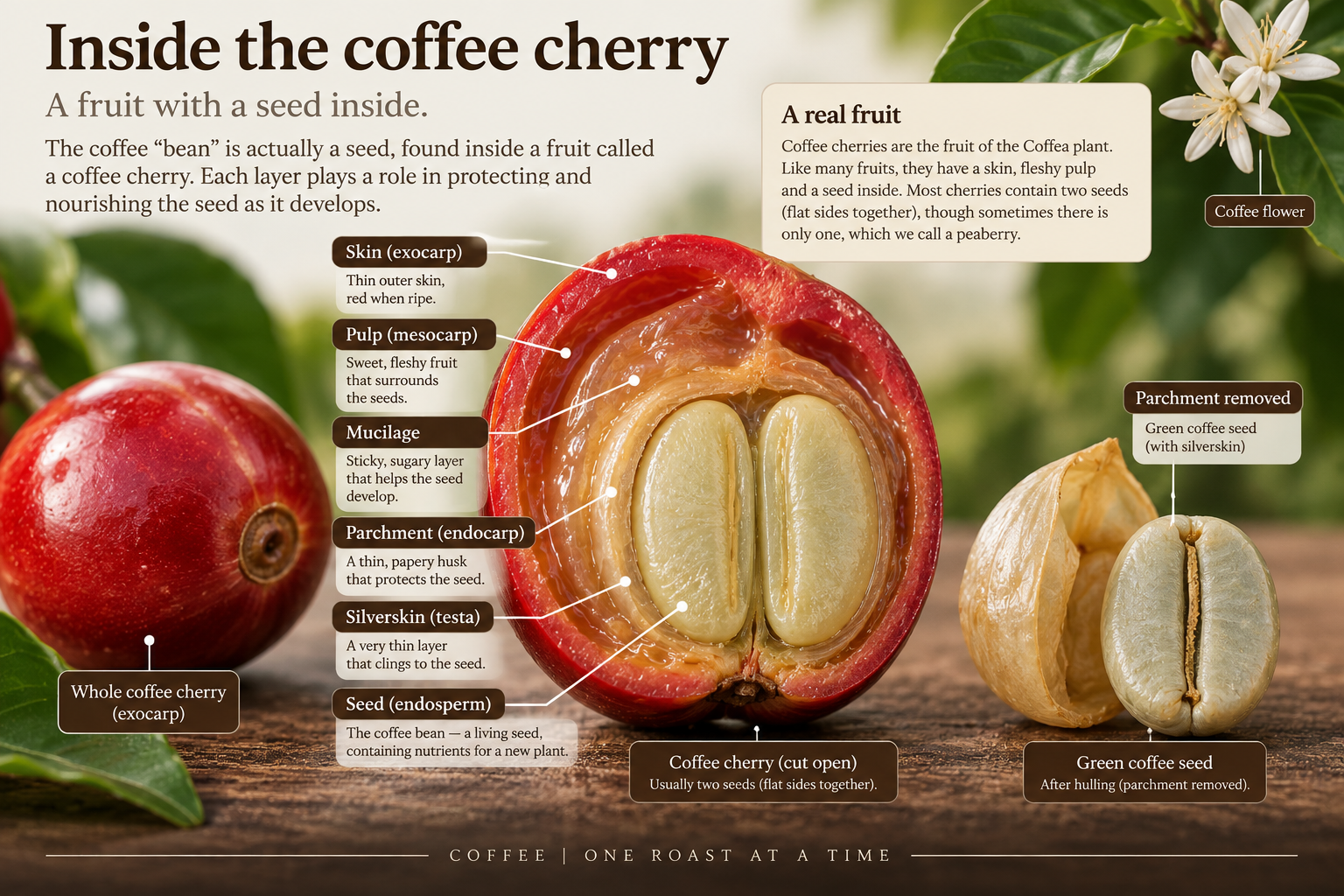
Cut open a ripe coffee cherry and the structure becomes easier to understand. Working from the outside towards the centre, we encounter several layers, each with a different role while the fruit and seed are developing.
Skin & pulp
The outer skin — the exocarp — surrounds the fleshy fruit tissue beneath it. Together these form much of what we recognise visually as the coffee cherry.
Mucilage & parchment
A sticky, sugar-rich mucilage surrounds the parchment layer. The parchment, or endocarp, forms a protective covering around each seed and remains important during processing and drying.
Seed & silverskin
Beneath the parchment is the coffee seed itself. A very thin seed coat, commonly called silverskin, clings to its surface. Much of this later separates during roasting as chaff.
ONE OR TWO?
Most cherries contain two seeds
A typical coffee cherry develops two seeds facing one another. The sides touching in the centre tend to be flatter, while the outside surfaces are more rounded.
Sometimes only one seed develops normally. With no second seed pressing against it, it can grow into a more rounded shape. This is what we call a peaberry.
Peaberry is therefore not a separate coffee species or variety. It describes a particular seed-development outcome inside the fruit.
A LIVING SEED
The coffee seed begins life as living plant tissue
This is one of the ideas I had barely considered when I first started roasting: the thing we eventually throw into a hot drum began as a living seed.
Inside it is an embryo capable, under suitable conditions, of developing into another coffee plant. Most of the seed is endosperm — stored material that supports the developing embryo and later becomes the physical material the roaster works with.
Fresh coffee seed can be biologically viable. But processing, drying, time and storage progressively change that living system. By the time coffee reaches us as commercial green coffee for roasting, whether a particular seed could still germinate depends on what has happened to it along the way.
Why that distinction matters
Calling green coffee simply a dry raw ingredient can hide its history. Its structure, water content and chemistry are the result of a biological system that developed on a plant and then passed through harvest, processing, drying and storage.
FROM FRUIT TO GREEN COFFEE
The fruit disappears. The seed continues.
Once the cherry is harvested, producers begin the work we broadly call processing. Different processing methods handle the fruit, mucilage, fermentation, water and drying in different ways, but eventually the aim is to create stable coffee that can be stored and transported.
At one stage the dried seeds may still be enclosed by their parchment layer. This is parchment coffee. Hulling removes that dry parchment, leaving the seed we recognise as green coffee.
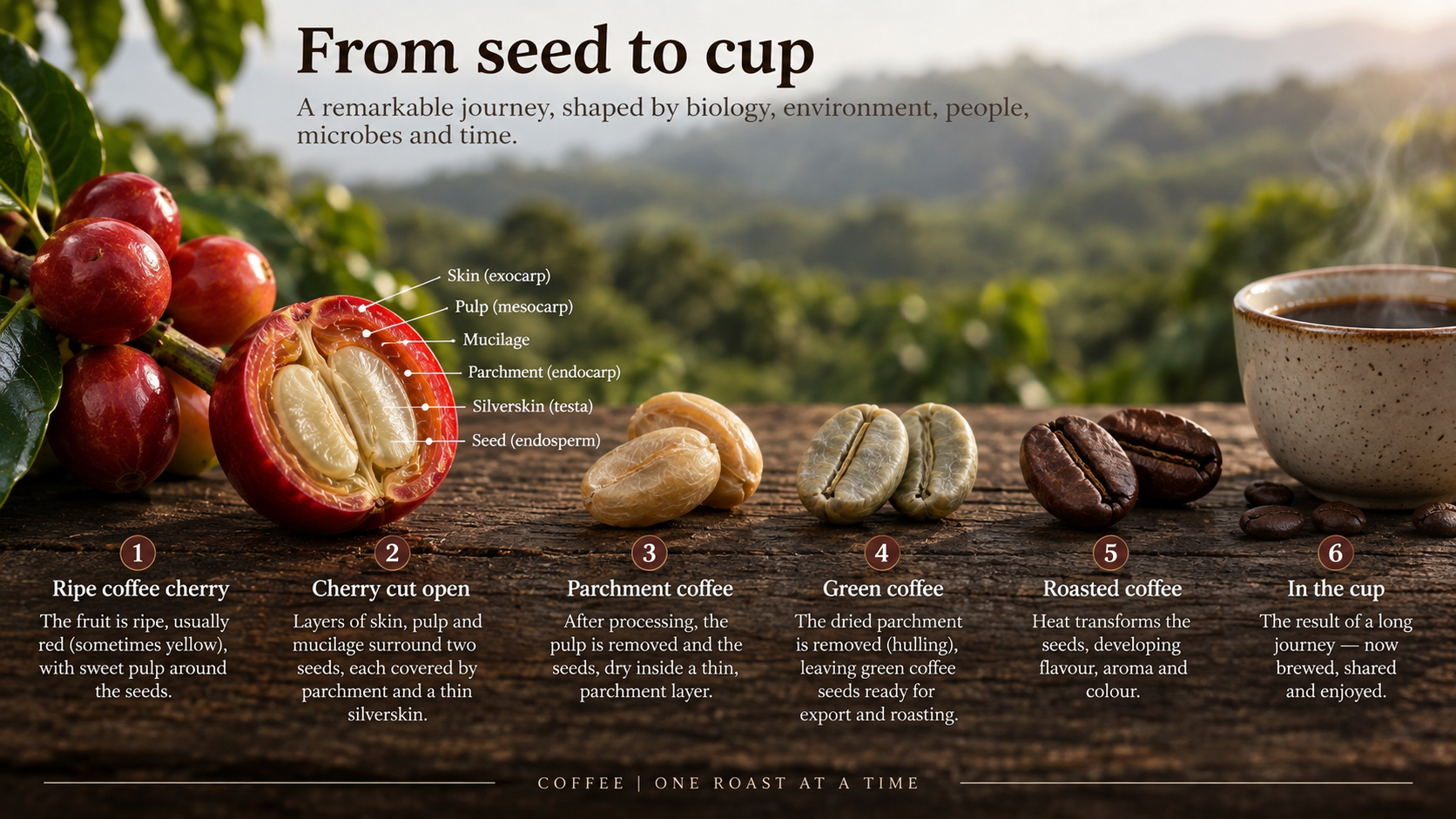
And one useful beginner distinction: green coffee does not mean unripe coffee cherry. “Green coffee” is the trade and roasting term for the dried, unroasted seed after processing.
WHY THIS MATTERS
The roaster does not begin with a blank ingredient
By the time green coffee reaches a roaster, its physical structure and chemistry already carry the consequences of everything that happened before: genetics, growing conditions, cherry development, harvest, processing, fermentation, drying, storage and time.
Roasting changes the seed dramatically, but it cannot rewind that history.
Structure
The seed brings its own physical structure, density, moisture distribution and previous drying history into the roaster.
Chemistry
The sugars, acids, amino acids, lipids and other compounds available to roasting reactions were shaped long before heat was applied.
History
Two green coffees can behave differently in the same roaster because they did not arrive there by the same biological and post-harvest path.
THE BIG IDEA
A coffee bean is the end of one story and the beginning of another.
For the plant, it is a seed.
For the producer, it sits at the centre of a fruit that must be harvested, processed and dried.
For the green-coffee trade, it becomes a stable agricultural product.
For the roaster, it becomes raw material.
And for the person drinking it, almost all of that history is invisible unless we choose to look backwards.
A NOTE ON THE VISUALS
Useful illustrations, not evidence
The anatomical images on this page are AI-generated educational visualisations. I use them to make structures that are difficult for an armchair enthusiast to photograph clearly easier to understand.
They are not microscope images, botanical plates or documentary photographs, and they should not be treated as primary evidence. Where the biology matters, the written explanation should stand on published sources rather than the illustration.
NEXT
The seed is not always the same seed
Once we understand what the coffee bean actually is, the next question is what makes one coffee plant — and one seed — different from another.
Next: Species & varieties
Arabica, Canephora, Bourbon, Typica, Gesha, Caturra and many more — where those names fit and what genetic differences actually mean.
Then: Processing
Follow what happens after harvest as fruit, mucilage, fermentation, water and drying begin to shape the coffee that reaches the roaster.