UNDERSTANDING COFFEE · ECONOMICS
How Coffee Gets Its Price, From the Farm Gate to the C Market and Specialty Coffee
Coffee pricing confused me for a long time and it still does sometimes. I would hear people talk about the “C price”, then hear that some specialty coffee had been bought for $4, $6 or even $10 a pound. Somewhere else I would see a farmer being paid for coffee cherry by the kilo, an exporter quoting an FOB price, an importer quoting a landed price, and a roaster selling the finished coffee for far more again. They all sounded like they were talking about the price of coffee, and it turns out they weren’t talking about the same price at all.
I wanted to understand this because I roast coffee at home. What I pay for green coffee runs from about 10 euro a kilo for the more accessible stuff up to 30 euro a kilo or more for specialty lots, with shipping on top. When I look at roasted coffee in Ireland I can find a bag online for 14 or 15 euro a kilo, and a few minutes later find a specialty coffee at 55 euro a kilo. Those numbers sit side by side on my screen and nobody really explains the gap. I’m not an expert and I’m learning this in public, so this is me working it out in plain English, the way I wish somebody had explained it to me. It also turns out you can’t really buy coffee without eventually bumping into futures trading, which I did not see coming.
A recent episode of The Coffee Producer Toolkit by Lucia Solis and James Harper is what pushed me to finally sit down and do this properly. Their episode “Price, Pt 1 — How the C market works” is aimed mainly at producers, and I found it fascinating. It also made me realise how little I knew about something that sits underneath so much of the coffee world. This article isn’t a retelling of it. I’ve rebuilt the mechanics from public sources and explained them from where I stand, as someone who buys, roasts and drinks the stuff. The sources are listed at the end.
There isn’t one coffee price
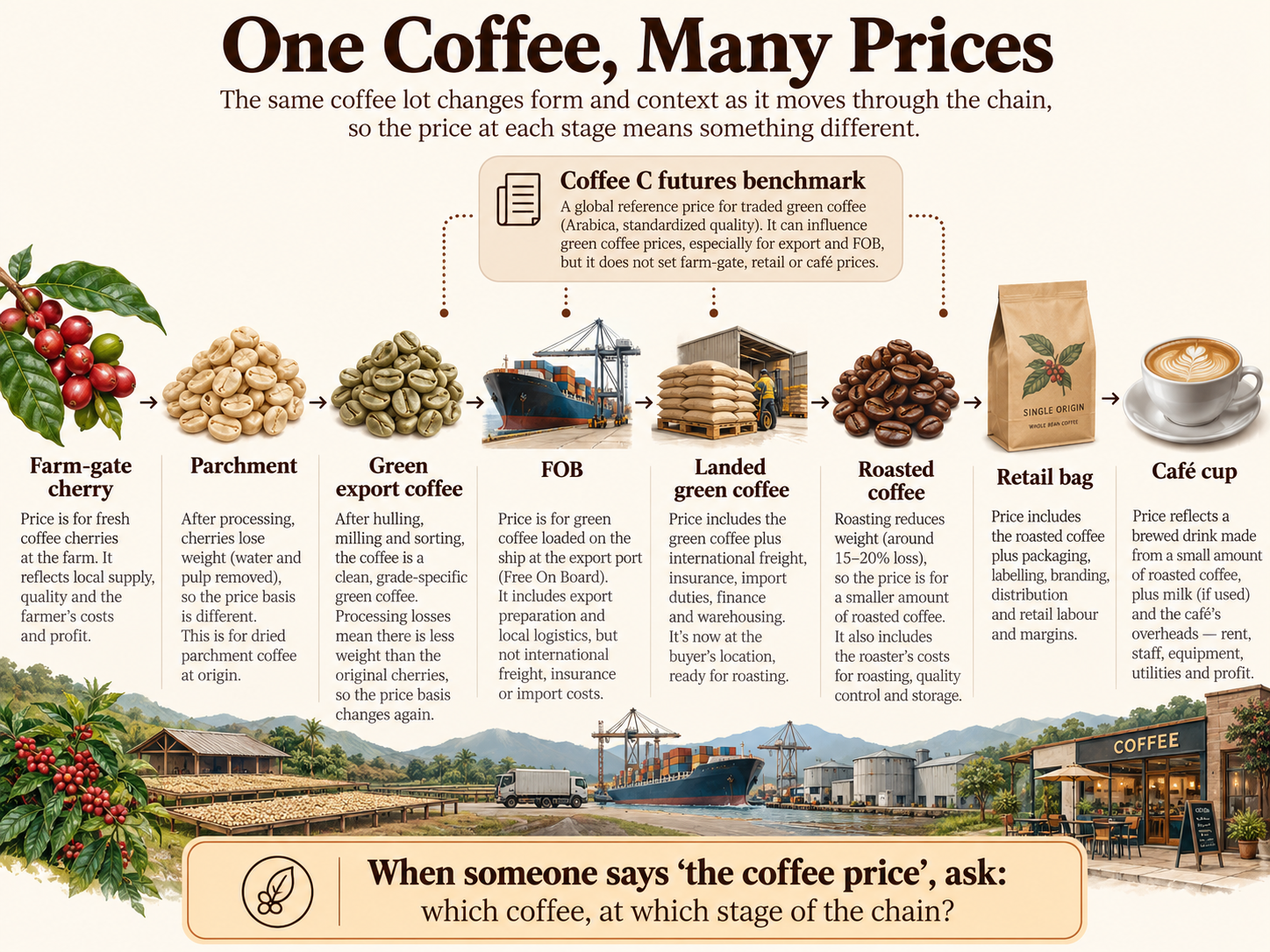
Follow a single coffee from the farm and you can see why. Cherries get picked, and at that point the coffee is still fruit. The farmer might sell the cherries straight away, process them into parchment, dry them whole as a natural, or hand them to a cooperative that does some of that work. Those are already different products, so they already have different prices. The price a farmer gets at or near the farm is called the farm-gate price, though even that isn’t perfectly standard everywhere.
You also can’t compare a price for fresh cherry with a price for green coffee because most of the cherry never makes it into the bag. The skin and pulp go, a lot of water goes, the parchment comes off and defects get sorted out. The amount of coffee has changed before anybody has made a penny of margin.
Further along we get to FOB, which means Free on Board. It’s the price of green coffee delivered on board the ship at the export port in the country where it grew. By then there has usually been milling, sorting, storage, transport, quality checks and the exporter’s own costs, so comparing the farmer’s price with the FOB price is already comparing two different things.
Then the coffee gets on a ship, and at the other end there’s a landed cost. That’s the FOB price plus freight, insurance, finance, warehousing, customs and everything else involved in getting it into the country and ready to sell to a roaster. And then it reaches the bit I can relate to, because roasting loses weight. In my own roasting I lose around 15 percent, so a kilo of green becomes about 850 grams of roasted coffee. That means my 10 euro green is already closer to 12 euro per roasted kilo before I’ve paid for electricity, packaging, my time or anything else, and my 30 euro green is already about 35 euro per roasted kilo.
That makes the shelf prices more interesting. If somebody is selling roasted coffee at 14 euro a kilo, the green behind it has to have cost well under 12 euro a kilo once the weight loss is counted, and that’s before they’ve paid for anything else. At the other end, if a roaster paid what I pay for my dearest green and sold it at 55 euro, the green would still be about two thirds of that price. The rest is overheads, roasting, packaging, labour, margin and what people are prepared to pay for that particular coffee. It doesn’t explain everything, but it starts to make the numbers less mysterious.
Put that roasted coffee in a café and there’s another whole business on top, with staff, milk, rent, machines, electricity, waste and tax. That’s why “the farmer got this much and I paid €4.50 for a cappuccino” can feel powerful and still be economically incomplete. There are serious questions about who captures the value in coffee, and I’m not dismissing them. I just think we need to know which number we’re looking at before we compare two of them.
Where the C price comes from
So far everything I’ve described is real coffee moving from one place to another, and each step has its own price. But there’s a second market running alongside it that most people in coffee talk about without ever really explaining.
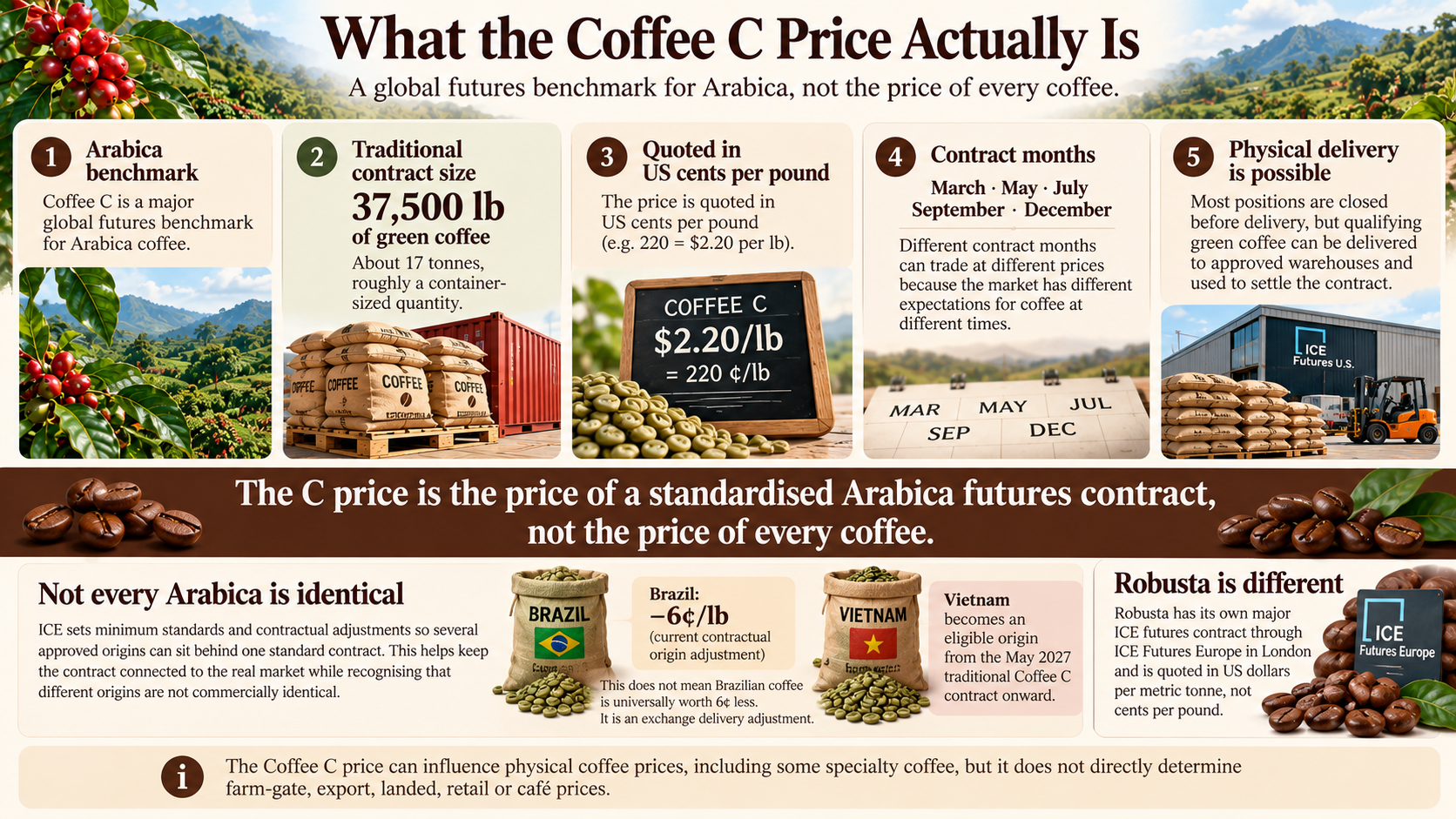
If you’ve read or listened to anything about coffee prices you will have heard someone say “the C price is up” or “the C price has crashed”, usually as if everyone knows what that means. I certainly didn’t, and for a long time I just nodded along. The C price is the price of a particular kind of contract for Arabica coffee, bought and sold on an exchange.
An exchange is basically a marketplace with fixed rules where people trade standardised things. In this case the exchange is ICE, the Intercontinental Exchange, and the contract is traded through ICE Futures U.S. It matters because a huge amount of physical coffee is priced with one eye on this market, including some specialty coffee.
One traditional Coffee C contract covers 37,500 pounds of green Arabica, which is about 17 tonnes or roughly a container. The price is quoted in US cents per pound, which is slightly irritating for someone who thinks in euro and kilos. The contract months are March, May, July, September and December.
There is a dated change to keep in mind here. As of October 2026, ICE has also listed a Coffee C Metric contract, covering 10 metric tonnes and quoted in US dollars per tonne. Its first expiry is May 2028; the traditional contract is scheduled to finish with March 2028. The 37,500 lb examples here use the traditional contract, so the arithmetic stays on one basis.
The months matter because each futures contract has one attached, and that month is roughly when the contract ends and coffee could be delivered. There can be a March contract, a May contract, a July contract and so on trading at the same time, and their prices don’t have to be identical because the market may expect coffee to be worth something different later in the year.
So if somebody says “December C”, they mean the December Coffee C contract. This is also why a physical coffee deal might be written as something like “December C plus 35”. The buyer and seller are not pointing vaguely at “the coffee price”, they are using one particular futures contract as the reference.
Futures make more sense if you start with the problem
The definition of a futures contract made much more sense to me once I thought about the problem it is trying to solve.
Imagine I agree today to sell roasted coffee to a café for the whole of next year at a fixed price, but I haven’t bought all the green coffee yet. If green coffee becomes much more expensive six months from now, the price I promised the café could suddenly become a terrible deal for me. What I would like is some way of reducing that uncertainty.
That is broadly the sort of problem futures markets are designed to help with. I could buy a futures contract now at today’s price, and if green coffee gets dearer by the time I need it, the contract gains value and helps cover the extra cost. For that to work the contract has to be standardised, so it’s worth saying what I mean by that. If you and I agreed a coffee deal privately we’d have to settle how much coffee, what quality, which origin, what month, where it gets delivered and who checks it, and every one of those is something we could disagree about. If every contract on the exchange was like that, nobody could trade one, because nobody could be sure what they were buying. Standardised just means the exchange fixes all those details in advance, so every Coffee C contract is the same as every other apart from the delivery month. It’s a bit like a euro coin. You don’t inspect it or negotiate over it, because you know exactly what it is. With everything else locked down the only thing left to argue about is the price, which is why thousands of people who have never met can trade the same contract all day.
Almost nobody simply waits until the end and takes delivery of 37,500 pounds of coffee. The contract itself changes in value as the market moves, which means the position can be closed before delivery by making the opposite trade.
Suppose I buy a futures contract when the market is at $2.00 per pound. Later the market rises to $2.40. I bought at $2.00 when the same contract is now worth $2.40, so the difference is 40 cents per pound. Across 37,500 pounds that’s $15,000. If the market had moved from $2.00 down to $1.60 instead, I would have lost roughly the same amount. In the rising-market case that is the useful outcome for my roaster example, because the green I still have to buy has got dearer but the contract has gained roughly the same. If the market had fallen I’d have lost on the contract, but my green would have been cheaper.
Being on the buying side is called being long. Being on the selling side is called being short. You don’t need to physically own a container of coffee to trade the contract, which is why people who never touch a coffee bean can trade in the same market as companies handling thousands of bags.
I used to think of this as “paper coffee”, and that’s partly right because most contracts are closed before delivery. But the Coffee C contract really can end in physical delivery. That physical connection matters because it helps keep the futures market tied to real coffee rather than becoming a completely separate financial game.
What counts as coffee for the contract
Not every Arabica is the same, so the exchange has to make different coffees comparable enough to sit behind one contract. It does that partly through minimum standards and partly through fixed adjustments for approved origins.
Brazil, for example, is deliverable against Coffee C at six US cents a pound below the contract basis. That doesn’t mean Brazilian coffee is universally “worth six cents less”. It simply means that if eligible Brazilian coffee is used to settle this particular futures contract, ICE applies that adjustment.
Other approved origins can have their own premiums or discounts. The reason is fairly practical. The exchange needs enough real coffee available behind the contract, but it also knows that coffee from different origins is not commercially identical. Those adjustments are a way of making different coffees comparable enough for one standard contract to work.
Vietnam is due to become a deliverable origin from the May 2027 traditional contract, at the same six-cent-per-pound discount as Brazil, widening that pool of real coffee further. These adjustments are not specialty premiums in the sense of somebody tasting a brilliant coffee and deciding it deserves more money. They are part of the contract rules.
Robusta is different again. Coffee C is Arabica, while Robusta has its own major futures contract through ICE Futures Europe in London and covers 10 tonnes, with physical delivery and prices quoted in US dollars per metric tonne rather than cents per pound. Even saying “the coffee futures price” can therefore be a bit sloppy unless we know which coffee and which contract somebody means.
Hedging, with one importer
The easiest way I’ve found to understand hedging is to follow one importer through a deal.
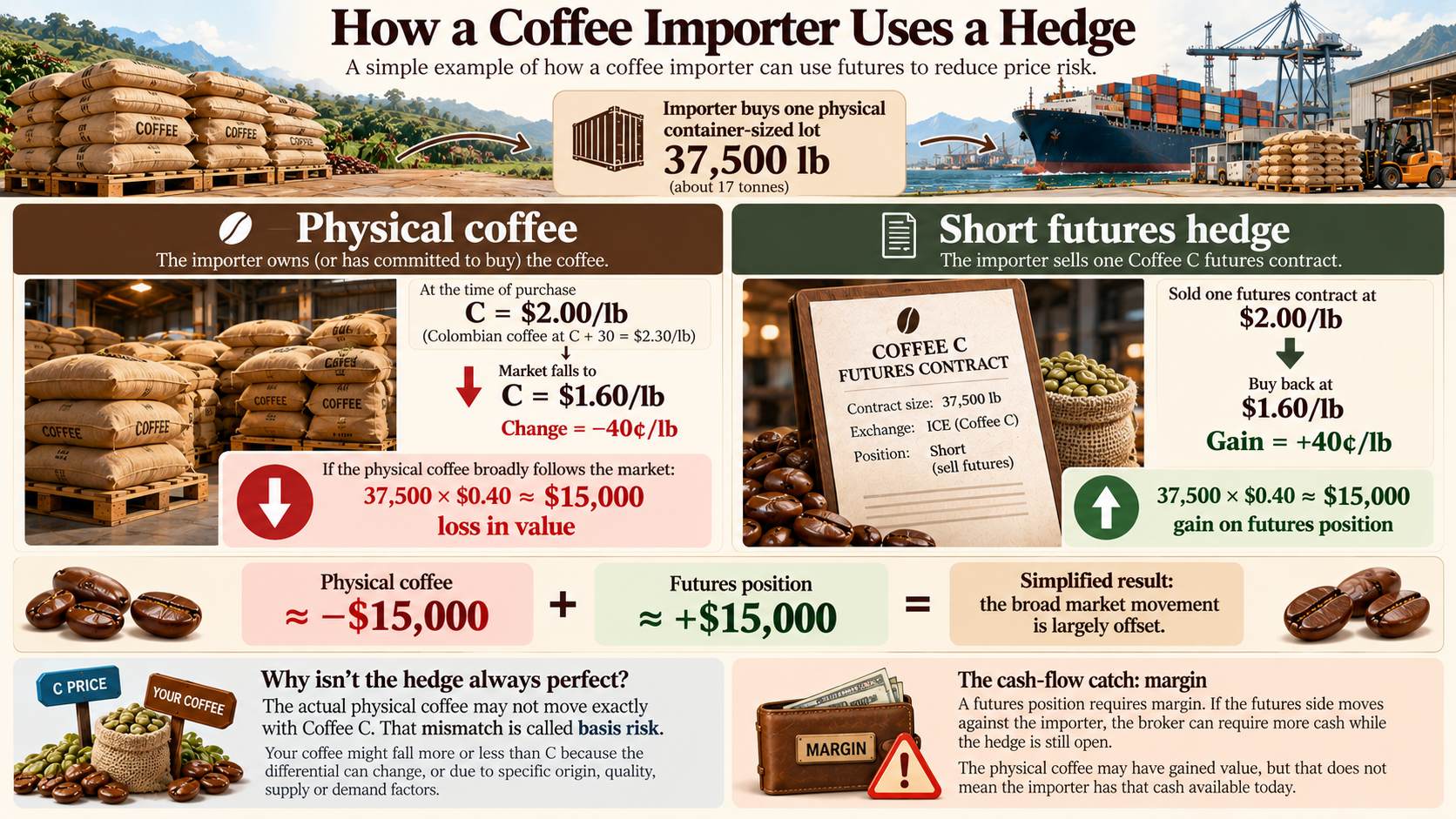
Say an importer agrees to buy a container of Colombian coffee weighing 37,500 pounds at a fixed price of $2.30 per pound. That price was worked out as the C price of $2.00 plus 30 cents for this particular coffee, and I’ll come back to that 30 cents below. The coffee may take weeks to arrive and months to sell on to roasters, and the importer doesn’t really want to spend that whole time betting on where coffee prices will go. Their business is buying, moving and selling coffee, not trying to guess the market.
So at roughly the same time as buying the physical coffee, they sell one Coffee C futures contract at $2.00.
Now imagine the market falls from $2.00 to $1.60. That’s a fall of 40 cents per pound. If the physical coffee follows the market reasonably closely, the container is now worth about $15,000 less.
The futures position moves the other way. The importer sold the futures contract at $2.00 and can now buy it back at $1.60, so the 40 cent difference works in their favour. Across 37,500 pounds that’s roughly $15,000.
In this deliberately tidy example the loss on the physical coffee and the gain on the futures contract more or less cancel each other.
If the market rises instead, the opposite happens. The physical coffee becomes more valuable, while the short futures position loses money. Again, one side largely offsets the other.
That was the bit that finally made hedging click for me. The importer isn’t really trying to win on the futures market. They are trying to stop a big market move from deciding whether the physical coffee deal works or not. They give up much of the benefit from a lucky price move in return for protection from an unlucky one.
The catch is cash
There is a catch, and it is a fairly important one.
When the importer sells the futures contract, the broker doesn’t ask for the entire value of 37,500 pounds of coffee. Instead the importer has to put money into the futures account as security. That’s margin.
For the sake of an easy example, imagine the margin requirement was $5,000. The real amount is set by the exchange and broker and changes over time, so the figure here is only to show how it works.
Suppose coffee prices now rise sharply. The physical coffee the importer owns has gone up in value, which is good, but the short futures position is losing money. The broker does not wait until the importer eventually sells the physical coffee. The futures account has to be kept funded as the market moves, and if there isn’t enough money in it the importer has to add more cash. That’s a margin call.
A hedge can be doing exactly what it was meant to do over the whole coffee transaction and still create a serious cash-flow problem in the middle of it. The importer may own coffee that is worth considerably more than before, but that doesn’t necessarily mean they have that extra value sitting in a bank account today.
It also helps explain why directly using futures is much easier for importers, exporters, larger cooperatives and bigger businesses than it is for many individual farmers. A traditional Coffee C contract alone represents 37,500 pounds, and then there is the broker, the margin requirement, the knowledge needed to manage the position and the cash needed if the market moves sharply.
Smaller producers can still get some protection indirectly through cooperatives, exporters, fixed-price contracts and other arrangements, but describing futures as a simple insurance policy that every farmer can use would be misleading.
The differential, and where the hedge stops fitting perfectly
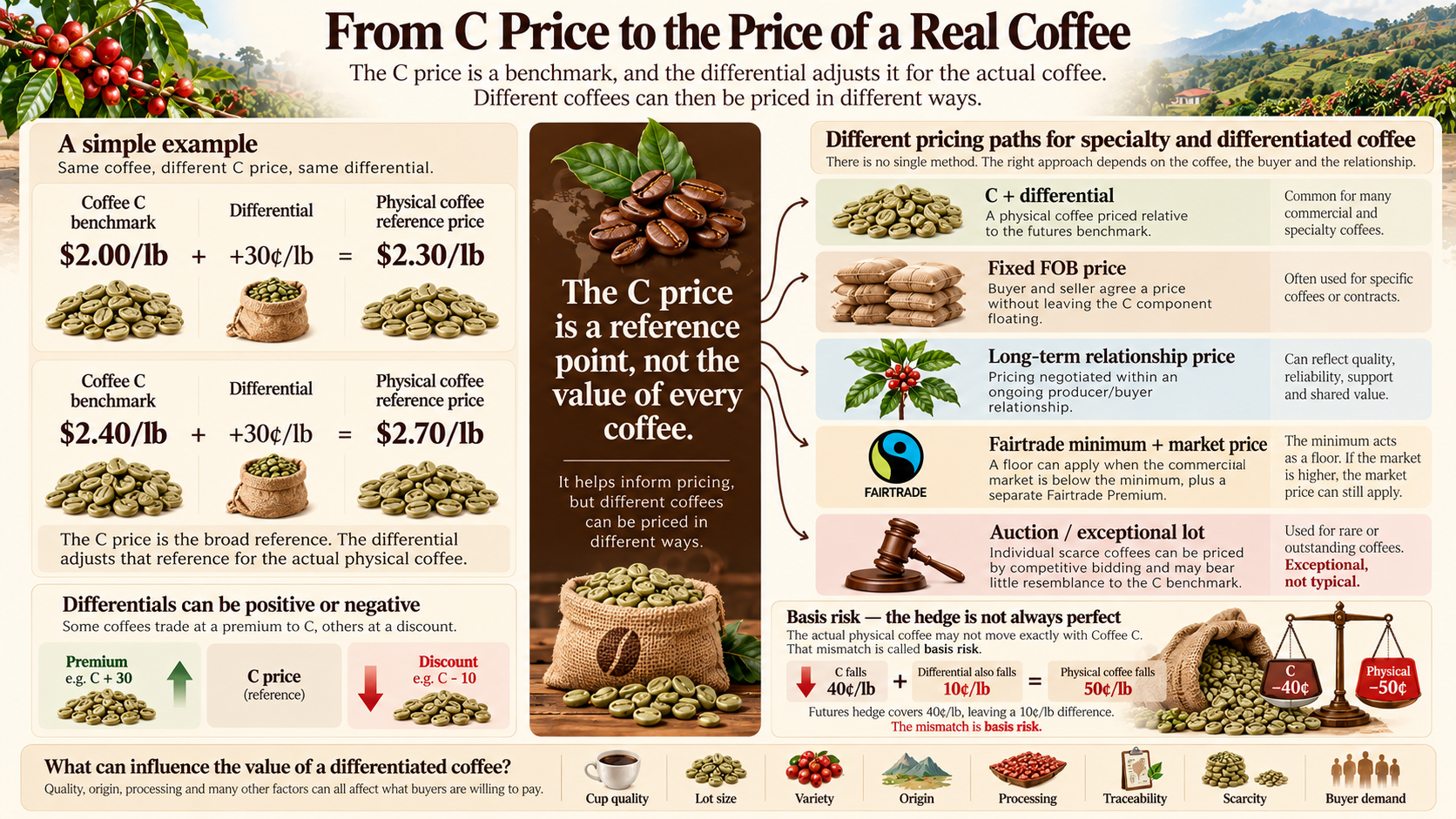
Go back to our Colombian coffee. The importer’s $2.30 was the C price of $2.00 plus 30 cents, and that “plus 30” is the differential.
I find it easiest to think of the C price as the broad market reference and the differential as the adjustment for the actual physical coffee. That adjustment can be positive or negative.
If C is $2.00 and the coffee is C + 30, the price is $2.30. If C rises to $2.40 and the differential stays at +30, the coffee is now $2.70.
But the differential can move as well. Perhaps demand for that particular type of Colombian coffee weakens and buyers are now only willing to pay C + 20. The C market might not have changed at all, but the physical coffee has still lost 10 cents per pound relative to it.
That matters because the futures hedge is mainly covering the C part. Imagine C falls by 40 cents and, at the same time, the differential falls from +30 to +20. The actual physical coffee has fallen by 50 cents in total, while the futures hedge has only gained 40 cents.
The remaining 10 cents is the mismatch. Across 37,500 pounds that’s $3,750.
That gap between what happens to the futures benchmark and what happens to the actual physical coffee is what people mean by basis risk. The hedge can protect against a large part of the broad market movement without perfectly protecting every change in the value of that particular coffee.
Price to be fixed
Many coffee contracts don’t have a completely final price on the day the deal is agreed. A buyer and seller might agree the coffee, quantity, delivery period and differential while leaving the C part floating.
You might see a contract written as “December C plus 35”. That means the final price will be whatever the December Coffee C contract is when it gets fixed, plus 35 cents per pound.
If December C is $2.00 on the fixing day, the coffee becomes $2.35. If December C is $2.60, it becomes $2.95. Same coffee, same differential, very different final price.
That is why the fixing date matters, and why it matters who gets to choose it. Hearing that somebody sold coffee at C + 35 doesn’t actually tell us the final price unless we also know what C was when it was fixed.
Who else is in the market
It isn’t only coffee companies trading futures. The US regulator, the CFTC, groups participants into categories that include businesses with real commodity exposure, swap dealers, investment funds and other traders.
Some are there because they genuinely need to manage the risk of a physical coffee business. Others are there because they think prices are going to rise or fall. That’s where the word speculator comes in.
I’m not particularly comfortable with either extreme on this. Saying speculators are villains who control coffee prices seems much too simple, but saying they have no effect at all doesn’t sound convincing either. They provide liquidity, because if somebody needs to sell a futures contract there has to be somebody willing to buy it, and they are part of the process through which the market arrives at a price. Regulators also monitor speculative positions and impose limits, so clearly the size and concentration of those positions matter.
I haven’t landed anywhere dramatic on it. The market is full of people wanting different things for different reasons, and for now I can live with that.
What moves the price
Weather is probably the easiest example. Brazil grows an enormous amount of coffee, so if traders think a frost or drought is going to reduce the crop, the market can move long before anybody knows exactly what the harvest will be.
That is an important part of how futures markets behave. They don’t wait until everything has happened and then price it. They are constantly trying to anticipate what might happen next.
Harvest forecasts, warehouse stocks, currencies, interest rates, shipping problems and expected demand can all matter. The balance between Arabica and Robusta matters too. All of those things feed, imperfectly, into what people are prepared to pay today for coffee that will be delivered later.
This is why the C market can sometimes move sharply even when nothing obvious has happened to the coffee sitting in anybody’s warehouse. The market is mostly looking forward.
What the C price doesn’t know
The C price doesn’t know what it costs a particular farmer to grow coffee. One farm might be a huge mechanised operation in Brazil and another might sit on a steep hillside where almost everything is done by hand. Their yields, wages, fertiliser bills, access to finance and production costs can be completely different.
The C market doesn’t examine each farm, work out what the coffee cost to produce and then add a fair profit. It is a market benchmark, not a cost-of-production calculator. That means a price can make perfect sense as the market price and still be too low for a particular farmer to survive on.
A high C price doesn’t automatically mean farmers are doing brilliantly either. Their costs may also have risen, yields may be down, and some producers may still be paying off debt accumulated during years of low prices.
There is another source of confusion here too. The number in a headline might be a futures price or an FOB price, while the producer receives a farm-gate price much further back along the chain. Futures price, FOB price, farm-gate price, producer revenue and producer profit are connected, but they are not the same thing.
What about the famous 1977 price
Coffee prices went extremely high in the late 1970s, particularly after the severe July 1975 frost in Brazil. That period comes up whenever modern coffee prices reach a nominal record.
The important distinction is between the number printed at the time and what that money was actually worth. Once inflation is taken into account, the purchasing power represented by the 1977 price was considerably higher than the raw number makes it look today.
I don’t think that means coffee “should” cost some particular inflation-adjusted amount now. The coffee industry, productivity, global supply, currencies and supply chains are all different. It simply shows that a record in nominal dollars is not necessarily a record in real value.
Where specialty fits
Specialty coffee is built around the idea that coffees are different. Variety, processing, cup quality, lot size, scarcity and traceability can all affect what somebody is willing to pay, as can the reputation of the producer and the relationship with the buyer. A coffee might also simply taste fantastic and be difficult to replace.
That is almost the opposite of a commodity market, where the whole point is to make coffee interchangeable enough for one standard contract to work.
Specialty still sits partly on top of that commodity system though. Some specialty contracts are priced using C plus a differential, others are agreed at a fixed FOB price, and some come out of long relationships where the price is negotiated more directly. Exceptional lots may go to auction and operate in something approaching a different pricing world altogether.
There isn’t one specialty pricing method, which is why I don’t think it is accurate to say specialty coffee is simply “C plus a premium”. Sometimes it is and sometimes it isn’t.
I can see that in my own buying. One green coffee might cost me 10 euro per kilo and another 30 euro, and the C market certainly hasn’t tripled between those purchases. The difference is in the coffee itself, the supply chain, how much exists, how desirable it is and what somebody is willing to pay for that lot.
The Specialty Coffee Transaction Guide is useful here because it looks at actual specialty transactions rather than asking a commodity benchmark what differentiated coffee should be worth. Its data shows prices changing with things like quality, lot size and origin, which makes sense when a tiny high-scoring lot is clearly not the same commercial product as a container of more everyday specialty coffee.
Auctions such as Cup of Excellence and Best of Panama make the distinction even clearer. Some of those prices look absurd beside the C market, but the buyers are not treating those coffees as interchangeable Arabica. They are competing for one particular lot from one producer because they want that coffee.
Fairtrade sits somewhere in between
Fairtrade is interesting because it still acknowledges the commercial coffee market but puts another mechanism underneath it.
There is a minimum price. If the commercial market is above it, the market can still determine the price. If the market falls below it, the Fairtrade minimum acts as a floor. This is an FOB floor for qualifying Fairtrade sales by producer organisations, not a guaranteed farm-gate payment to every farmer. There is also a separate Fairtrade Premium of 20 US cents per pound, paid on top of the selling price.
At the time I’m writing this in October 2026, the minimum for conventional washed Arabica is $1.80 per pound and Fairtrade has announced that it will rise to $2.00 from 1 December 2026.
I find that quite telling. Fairtrade isn’t saying the commodity market is meaningless. It’s saying that sometimes the market on its own isn’t enough.
So why have futures at all
They solve a real problem, because coffee takes a long time to get from a tree to somebody’s cup. It is grown, harvested, processed, stored, exported, shipped, imported, stored again and eventually sold, and prices can move substantially during that time. Businesses need some way of dealing with that uncertainty and futures give them one.
Where I think the confusion starts is when we ask the C market questions it was never designed to answer. It doesn’t know what income a farmer needs for a decent life, what unpaid family labour is worth or whether a particular Ethiopian natural tastes extraordinary. It has no idea whether a Geisha deserves to cost five times more than something else, because those aren’t the problems it was built to solve.
Where I’ve ended up
If somebody asked me now what “the price of coffee” is, I’d probably answer with another question, which is which coffee, and where in the chain. A year ago I wouldn’t even have known that was the question to ask.
The C market matters a lot. It gives Arabica a global benchmark, allows businesses to manage some of their price risk and plays a major part in how prices are discovered. But it isn’t “the value of coffee”. A futures quote tells us something different from an FOB price, FOB tells us something different from what the farmer actually received, and none of those numbers tell us whether the producer made a profit. The price of a roasted bag or a cup in a café is several businesses further down the road again.
Specialty coffee sits in an odd place inside all of this. It lives within the wider commodity coffee economy while also trying to treat coffees as individual things with their own value. The more distinctive a coffee becomes, the less a generic benchmark tells us about what that particular coffee is worth, but the benchmark never completely disappears. It still affects risk, financing, replacement costs and expectations.
So even if the coffee in my grinder was bought at a fixed price and never once had “C + anything” written on its contract, it still travelled through a coffee economy partly shaped by the C market.
Having finally spent the time trying to understand it, I don’t think I’ll look at the price on a bag quite the same way again.
Sources and acknowledgement
This article was prompted in part by Lucia Solis and James Harper’s Coffee Producer Toolkit episode “Price, Pt 1 — How the C market works”. Their work is aimed mainly at producers and goes much further into cost of production, price discovery and negotiation.
I’ve taken a different route here and tried to understand the system from my own end of the chain, as somebody buying green coffee, roasting it and wondering how all these numbers connect.
The market details were checked on 4 October 2026 against public material from ICE Futures U.S. — traditional Coffee C, ICE’s metric-contract transition notice, ICE Futures Europe — Robusta, the CFTC’s explanation of futures and hedging, its basis-risk glossary and trader classifications, Fairtrade’s July 2026 price announcement, and the Specialty Coffee Transaction Guide. For the historical passage, I used a contemporary IMF account of the 1975 frost and 1977 market and the US Bureau of Labor Statistics explanation of purchasing power and constant dollars.
I’m sure I’ll come back and change things here as I learn more. Coffee has a habit of doing that to me.
For the wider seed-to-cup learning route, return to Understanding Coffee.