ROASTING | KALEIDO M2-C
One Month with the Kaleido M2-C: Twenty Roasts Later
It’s been about a month since I closed the Gene Café chapter and started learning my way around the Kaleido M2-C. At the time, I had completed 215 roasts on the Gene Café and was looking forward to having more control, better temperature information and the opportunity to explore coffee roasting in a little more detail.
Twenty roasts later, I thought it was time to share how things are going. I’ve learned quite a bit about the M2-C in that time, although I’ve also discovered there’s considerably more to understand than I initially appreciated. There have been a few frustrations, some interesting discoveries and, particularly during the early days, a couple of roasting results that probably wouldn’t have troubled the judges at a coffee competition.
But I’m enjoying the experience, and the machine is beginning to feel familiar. This isn’t intended to be a comprehensive review. It’s an account of my first month with the M2-C, what I’ve learned, what I like, what could be better and where I hope to take things next.
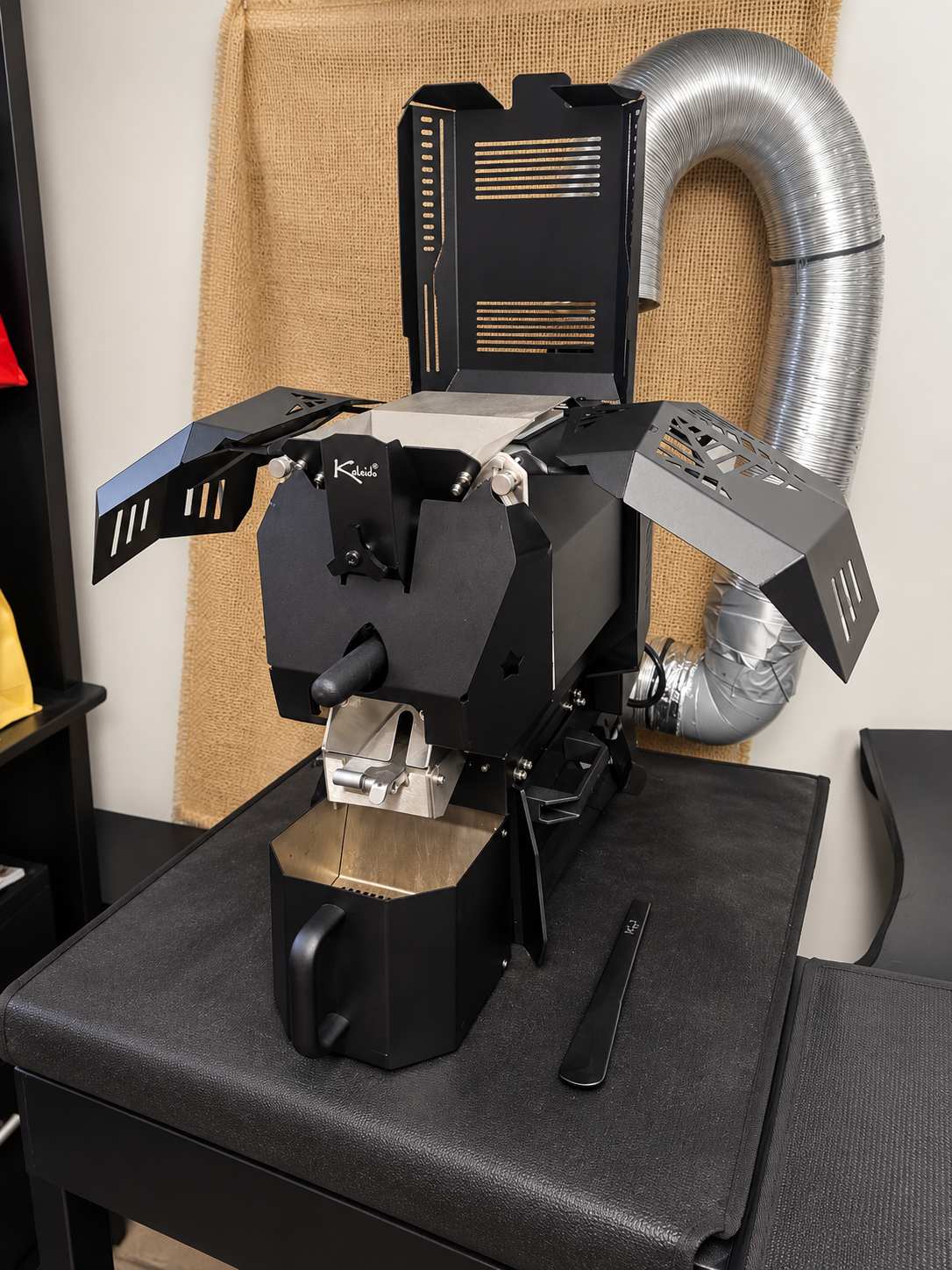
The Kaleido M2-C in my roasting setup.
A rather different way of roasting
Moving from the Gene Café to the Kaleido M2-C was quite a substantial change. With the Gene Café, I’d become comfortable with a relatively straightforward roasting process. I could adjust the target temperature, watch the coffee through the glass, listen for first crack and make decisions based on experience. After 215 roasts, I had a reasonable understanding of how the machine behaved.
The M2-C introduced quite a few more variables. I now have independent controls for heater output, airflow and drum speed, along with temperature probes and the ability to record the entire roasting session using Artisan. On paper, that was exactly what I wanted. In practice, it meant learning a new machine and becoming familiar with a fairly powerful piece of software at the same time.
And Artisan has probably been the biggest part of that learning experience. I’m using Artisan 4.2.0, connected directly to the M2-C. It gives me a much more detailed view of what’s happening during a roast, but there’s also a considerable amount to learn before you become comfortable using it. The first challenge was understanding how the controls interacted, what the temperature readings represented and how to establish a sensible routine. As I discovered fairly quickly, getting something wrong can have a rather dramatic effect on the coffee.
A promising start. If you happen to like charcoal.
Some of my earliest attempts at learning the M2-C and Artisan were, shall we say, less than successful. I was trying to understand how everything worked together, particularly the relationship between Artisan, the heater controls and the machine itself. The results weren’t always what I had intended.
In fact, one of those early learning experiences produced coffee that looked considerably more suited to keeping a barbecue going than making a decent espresso. I took a photograph at the time, partly because I thought it was funny and partly because it seemed worth documenting just how badly things could go while I was learning.
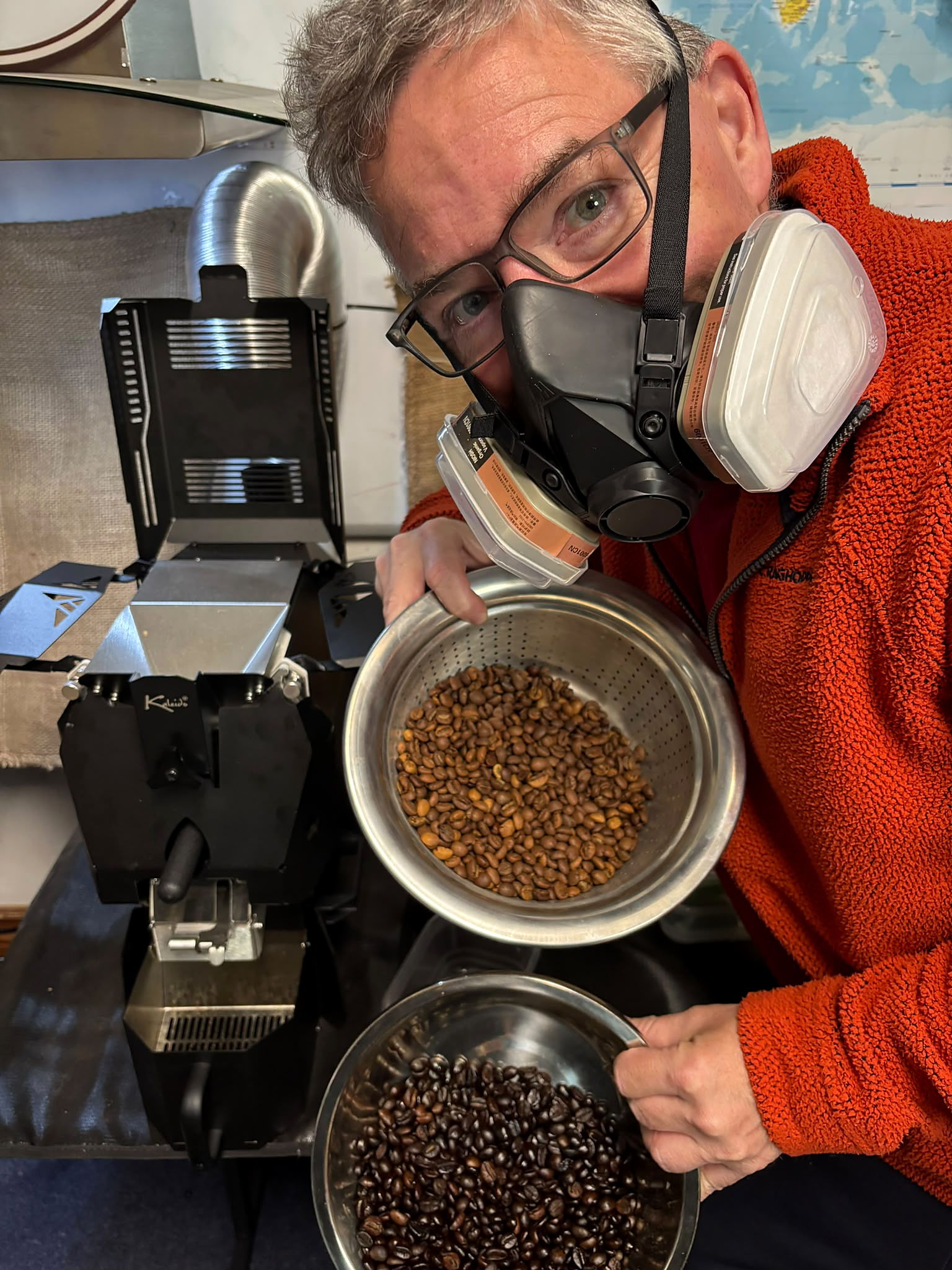
Early Artisan adventures. At least the barbecue fuel was sorted.
Looking back, it’s quite an entertaining reminder of those first few days. At the time, though, it reinforced something important. Having more control over a roaster is useful, but you need to understand what those controls are doing before you can make sensible decisions with them. Artisan is a remarkably capable application, and the M2-C provides a lot of flexibility, but there’s a learning curve involved in bringing the two together.
Fortunately, things have improved considerably since those early adventures. I’ve settled into a more consistent routine, become more familiar with the controls and, perhaps most importantly, I’m producing coffee that I’d actually want to drink. Which is generally considered a useful feature of a coffee roaster.
Finding a routine that works
One of my priorities was establishing a consistent way to prepare the machine and start each roast. My current approach is to bring the M2-C up to temperature using automatic control, with a set value of 180°C. Once I’m ready, I mark CHARGE in Artisan while the drum is still empty, switch to manual operation, normally using 50% heater output and a 215°C set value, and then physically add the beans a few seconds later.
I’ve also configured Artisan to simplify some of those steps, reducing the number of separate actions I need to perform during preparation. These are settings I’m using while learning this particular machine. I wouldn’t suggest they’re necessarily ideal for every coffee, but they’re giving me a reasonably consistent starting point.
That consistency is important because one of the things I want to understand is how repeatable the M2-C can be. If I prepare the machine in much the same way, roast the same coffee and use similar settings, how closely will the results match? And if they don’t match, can I work out why?
The temperature readings have already raised a few interesting questions about what happens during preheating and how the machine behaves between consecutive roasts. Getting a temperature reading to settle at a particular value doesn’t necessarily tell me everything about the heat stored throughout the machine. I’m beginning to appreciate the difference between what the instruments can show me and what I might be tempted to assume from those readings.
Twenty roasts and a few interesting discoveries
The first twenty roasts have involved a mixture of familiarisation, establishing a baseline, adjusting the roasting process and experimenting with different batch sizes. I started with 250 g batches, which felt familiar after the Gene Café. More recently, I’ve moved into larger batches, including 400 g roasts of Kenyan, Honduran and Colombian coffee.
The larger batches have been particularly interesting. When I compare the recorded temperature curves, the 400 g roasts generally follow a noticeably slower temperature path than the smaller batches I’ve examined. The indicated bean-temperature probe reading recovers more slowly, and the marked first crack tends to arrive later. The additional coffee may be part of the explanation, although the comparisons aren’t perfectly controlled: different coffees and preparation conditions also influence the results.
What I found particularly encouraging was how closely two consecutive 400 g Kenyan roasts followed one another through much of their early development. They weren’t identical roasts, and I deliberately extended the time after first crack on the second batch because I wanted to explore a different finishing point. But seeing those temperature responses so close together suggested I was beginning to establish some consistency in the way I was operating the machine. Whether that translates into consistently similar coffee is another question entirely.
I’ve also started using a CoffMeter A1 to measure roast colour, alongside the more familiar measurements of roasted weight and percentage weight loss. Those additional measurements are useful when comparing batches, but I’m learning to be careful about what conclusions I draw from them. Two coffees might have similar measured colour and weight loss, yet have followed quite different paths through the roast. Even if I can identify those differences on a graph, that doesn’t necessarily tell me which coffee I’d prefer to drink.
What I like about the M2-C
The biggest improvement over the Gene Café is the amount of control available. Being able to adjust heater output and airflow independently gives me opportunities to explore roasting in ways that weren’t particularly practical with my previous machine. I can make a deliberate change during a roast, see how the recorded temperatures respond and examine the results afterwards.
Having Artisan as part of that process is a significant advantage. I particularly enjoy being able to put two roast profiles alongside one another and look at the differences. Sometimes the results are exactly what I expected. Occasionally, they raise questions I hadn’t considered before.
The additional batch capacity is welcome too. Being able to roast smaller quantities while also working with 400 g batches provides flexibility, particularly when I’m experimenting with different coffees or trying to understand how batch size influences the roasting process. I’m not yet convinced that one particular batch size is automatically better than another. That’s something I’d rather work out through experience and, ultimately, the coffee in the cup.
I also appreciate that the M2-C makes me pay closer attention to what happens during a roast. I’m thinking more carefully about preparation, how the temperature readings respond, when first crack occurs and what happens during the final part of the roast. Those things mattered with the Gene Café too, but I now have better ways to investigate them. And despite the somewhat questionable results of my early attempts, I’m enjoying the roasting itself.
What could be better?
It hasn’t been an entirely trouble-free first month. There were some early temperature-related machine issues that interrupted the initial learning process and needed attention before I could settle into normal roasting. Those problems were frustrating, particularly with a new machine, although I’ve subsequently been able to continue roasting and concentrate on learning how it behaves.
The interaction between Artisan and the M2-C has also taken some getting used to. There are quite a few settings and controls involved, and it isn’t always immediately obvious how the software’s automatic functions interact with the actions I’m taking manually. I’ve had instances where Artisan recorded a charge event incorrectly, requiring me to correct the marker afterwards.
That matters because those events become part of the roast history. If a marker doesn’t correspond with what physically happened, later comparisons can become misleading. I’ve become much more deliberate about recording those events, and I’ve made some changes to my Artisan configuration to simplify the process.
There are still things I’d like to understand better, particularly around event recording and making the overall roasting workflow as straightforward as possible. I wouldn’t necessarily describe all of that as a criticism of the machine. Some of it comes with learning unfamiliar software and a more sophisticated control system. But it’s part of the experience, and I think it’s worth mentioning rather than pretending everything worked perfectly from the beginning.
Better measurements. But what about better coffee?
One thing I’m increasingly conscious of is the difference between being able to measure a roast and understanding what those measurements mean. With the M2-C, I can watch bean-temperature and environmental-temperature probe readings, examine rate of rise, review heater settings and compare the electrical power used during different roasting sessions. I’ve also been recording whole-machine electrical consumption independently using a Shelly meter.
That gives me a substantial amount of information to explore. But the temperature probes aren’t measuring the precise internal temperature of every bean, and the electrical meter isn’t telling me how much energy the coffee itself has absorbed. The information is useful, provided I understand its limitations.
And there’s a more fundamental question I’ve been thinking about. After more than 230 roasts across the Gene Café and M2-C, I’m reasonably comfortable producing coffee that I enjoy drinking. What I’m less confident about is whether I can consistently identify when a particular roasting adjustment has genuinely improved the cup.
I might produce two roasts with noticeably different curves, different weight losses and different finishing temperatures. But can I reliably taste the difference? And if I can, do I actually prefer one over the other? That’s something I want to spend more time exploring. It probably means developing my sensory skills alongside my understanding of the machine.
I’m interested in learning how to compare coffees more consistently, without turning something I enjoy into an unnecessarily complicated exercise. I can already see the value in measuring roast colour, comparing profiles and recording what happens during a roast. Ultimately, I want those measurements to help me make coffee that I enjoy drinking.
At least we’re making drinkable coffee now
One of the more satisfying things about looking back over the first month is seeing how much more comfortable I’ve become with the machine. Those early Artisan adventures were a fairly dramatic introduction, but they were also part of learning how everything worked.
Since then, I’ve established a routine, become more familiar with the controls and started making more deliberate decisions during my roasts. The coffee coming out of the machine is certainly a considerable improvement on those first experiments. I’m now at the point where I can concentrate on producing enjoyable coffee while using the additional information to understand what happens along the way.
There’s still plenty of room for improvement, and I’m not going to pretend that I’ve discovered the perfect roast profile. But I am making progress, and I think the contrast between those early results and what I’m producing now demonstrates that rather nicely.
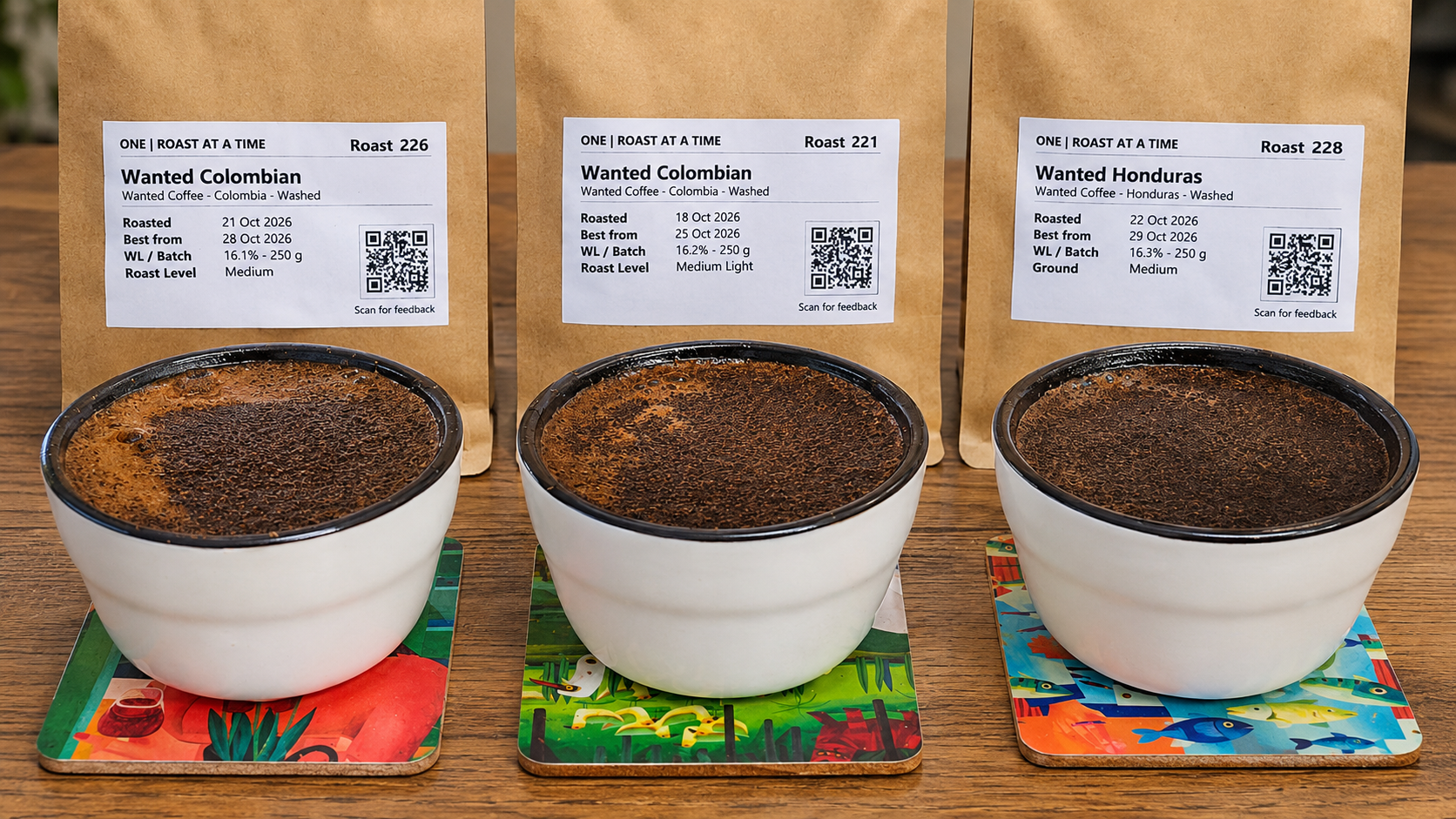
Moving on to something more useful: comparing recent roasts side by side.
Where do we go from here?
The first month has largely been about getting comfortable with the M2-C and learning how it behaves. I now have twenty roasting sessions behind me, a growing collection of Artisan recordings and a much better understanding of the controls than I had when the machine arrived.
Repeatability is probably one of the most interesting questions ahead. I’d like to understand how closely I can reproduce a roast using the same coffee, batch size and preparation routine, and whether that consistency extends beyond the graphs into roast colour and flavour.
I’m also interested in the relationship between batch size, roasting time and the finished coffee. The 250 g and 400 g comparisons have already given me something useful to investigate, but there are questions that the data alone can’t answer. And I want to become more confident about what happens after first crack. I’ve been experimenting with different finishing times, but I’d like to understand how those decisions influence the coffee I actually drink.
Alongside the roasting, I’ll continue exploring Artisan and sharing some of the practical things I’ve learned. It’s a remarkably capable application, although there are times when I suspect learning the software could become a hobby in its own right.
Beyond the M2-C, Coffee | One Roast at a Time will continue exploring the wider world of coffee, from the people who grow it and the decisions made during processing to the science of roasting and brewing. The machine is where I’m currently doing much of my learning, but there’s a lot more to coffee than the equipment we use to roast it.
One month on
Would I make the same decision to move from the Gene Café to the Kaleido M2-C? Based on what I’ve experienced so far, yes. The machine has given me much of the additional control and information I was looking for, and I’m finding the learning process enjoyable. There have been some frustrations, particularly during those early days, and I’ll be interested to see how the machine performs over a longer period.
I’m also aware that I’ve barely begun exploring everything it can do. Twenty roasts have been enough to establish a working routine, start making useful comparisons and discover quite a few things I didn’t know when I bought it. And, perhaps most importantly, the coffee is now considerably more drinkable than those early experiments might have suggested.
For now, I’m going to keep roasting, keep recording what happens and spend a little more time comparing the coffee that comes out of the machine. I suspect the tasting side of this journey might turn out to be every bit as interesting as learning the controls.
Photo note: The photographs in this article originate from real ORAT photographs and have been tidied or enhanced with AI. Some visual details may have been altered during that process.