Context
Over time, a recurring observation during roasting on the Gene Café CBR-301 began to stand out.
Across many roasts, the machine appeared to change behaviour around the same point in the roast. The airflow seemed to increase, the roast environment stabilised, and the rate of temperature rise often became more predictable.
At first this appeared to occur around four minutes into the roast, but further analysis suggested that time itself might not be the true trigger.
The Gene Café application exports detailed roast logs in JSON format, including time, environmental temperature, and fan state. These logs provide enough information to investigate the behaviour more carefully.
Data Source
The dataset used here consisted of roast logs exported from the Gene Café application.
Across the dataset:
- 58 roasts were analysed
- each roast log records time, temperature, and fan speed
- fan state changes can therefore be extracted directly
Using a simple Python script, every fan transition event was extracted from the logs.
Two events are particularly relevant:
- Fan 2 → Fan 3 (increase in airflow)
- Fan 3 → Fan 2 (recovery to lower airflow)
Fan Increase Events
Across the dataset, the fan increase events clustered very tightly around the same temperature band.
| Metric | Value |
|---|---|
| Mean | ~204 °C |
| Median | ~203 °C |
| Range | 194–212 °C |
Although the time at which this occurred varied between roasts, the temperature was consistently close to ~200 °C.
This suggests that the airflow change is likely triggered by temperature rather than time.
Fan Recovery Events
In a small number of roasts, the fan was also observed to return from Fan 3 → Fan 2.
These recovery events occurred at slightly lower temperatures.
| Metric | Value |
|---|---|
| Mean | ~199 °C |
| Median | ~198 °C |
| Range | 195–201 °C |
Although these events are less frequent, they suggest the machine may operate within a temperature control band rather than using a single fixed threshold.
Possible Interpretation
Taken together, the observations suggest the machine may be using a small temperature window for airflow control.
One possible interpretation is a behaviour similar to:
- airflow increases when environmental temperature rises above roughly ~203–205 °C
- airflow may reduce again if temperature falls below roughly ~198–200 °C
This type of control band (often called hysteresis) is commonly used in embedded systems to prevent rapid oscillation between states.
However, this remains an interpretation of observed behaviour, not a confirmed description of the machine’s firmware.
Why This Matters in Practice
From a roasting perspective, this observation helps explain something many users notice.
Early in the roast:
- heat builds quickly
- airflow remains lower
- temperature rise can vary more between roasts
Once the roast passes roughly ~200 °C:
- airflow increases
- heat transfer stabilises
- roast progression often becomes more predictable
This may also help explain why total roast time (TRT) often becomes a more reliable indicator of roast development after this point.
Status of This Observation
This note records a pattern observed in roast data, not a definitive explanation of machine design.
Further roasting across different coffees and conditions may strengthen or challenge the interpretation.
For now, the consistent clustering of airflow transitions around ~200 °C is simply an interesting and useful observation.
Practical Takeaway
For users of the Gene Café CBR-301, it may be helpful to think of the roast in two broad phases:
- Below ~200 °C
Heating phase, airflow lower, behaviour more variable. - Above ~200 °C
Airflow increases and the roast environment appears to stabilise.
Recognising this transition point may make the machine’s behaviour easier to interpret during a roast.
Visualising the Transition
To better understand the pattern, the temperature of each Fan 2 → Fan 3 transition was plotted across the dataset.
The resulting distribution shows a strong clustering around ~200–210°C, supporting the observation that airflow increases near this point in the roast.
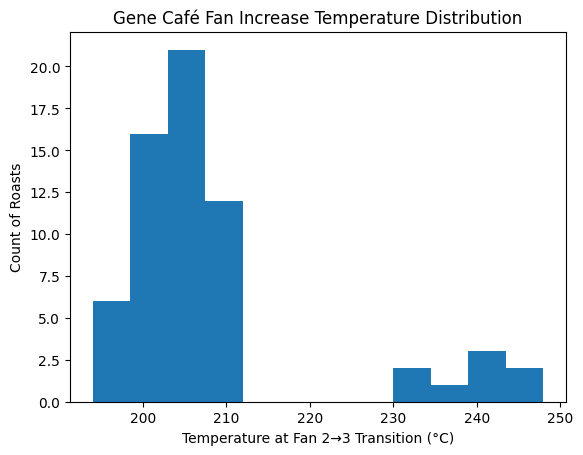
A small number of transitions appear at higher temperatures. These are likely associated with thermal protection events, which temporarily increase airflow when the machine approaches internal safety limits.