ROASTING / THE NEXT CHAPTER
Moving from the Gene Café to the Kaleido M2
The next chapter is now real: the Kaleido M2 has been ordered, and the project is moving from researching a more capable roaster to learning how to use one properly.
I have spent much of 2026 learning the Gene Café CBR-301 through repeated 250 g roasts, careful record-keeping and a growing collection of temperature, power and acoustic evidence. That work has done exactly what I hoped it would do: not give me all the answers, but teach me how to ask better questions.
The Kaleido M2 is the next step. It should expose more of what is happening during a roast and give me more meaningful control over heat, airflow and drum behaviour. That also means fewer places to hide. More control only becomes useful if I understand why I am using it.
The M2 was ordered on 3 September 2026 and has not arrived yet. So this is still not a review. This page now records the transition from purchase research into arrival, commissioning and first-hand learning. Supplier specifications and claims will remain labelled as such until I can verify them on the actual machine.
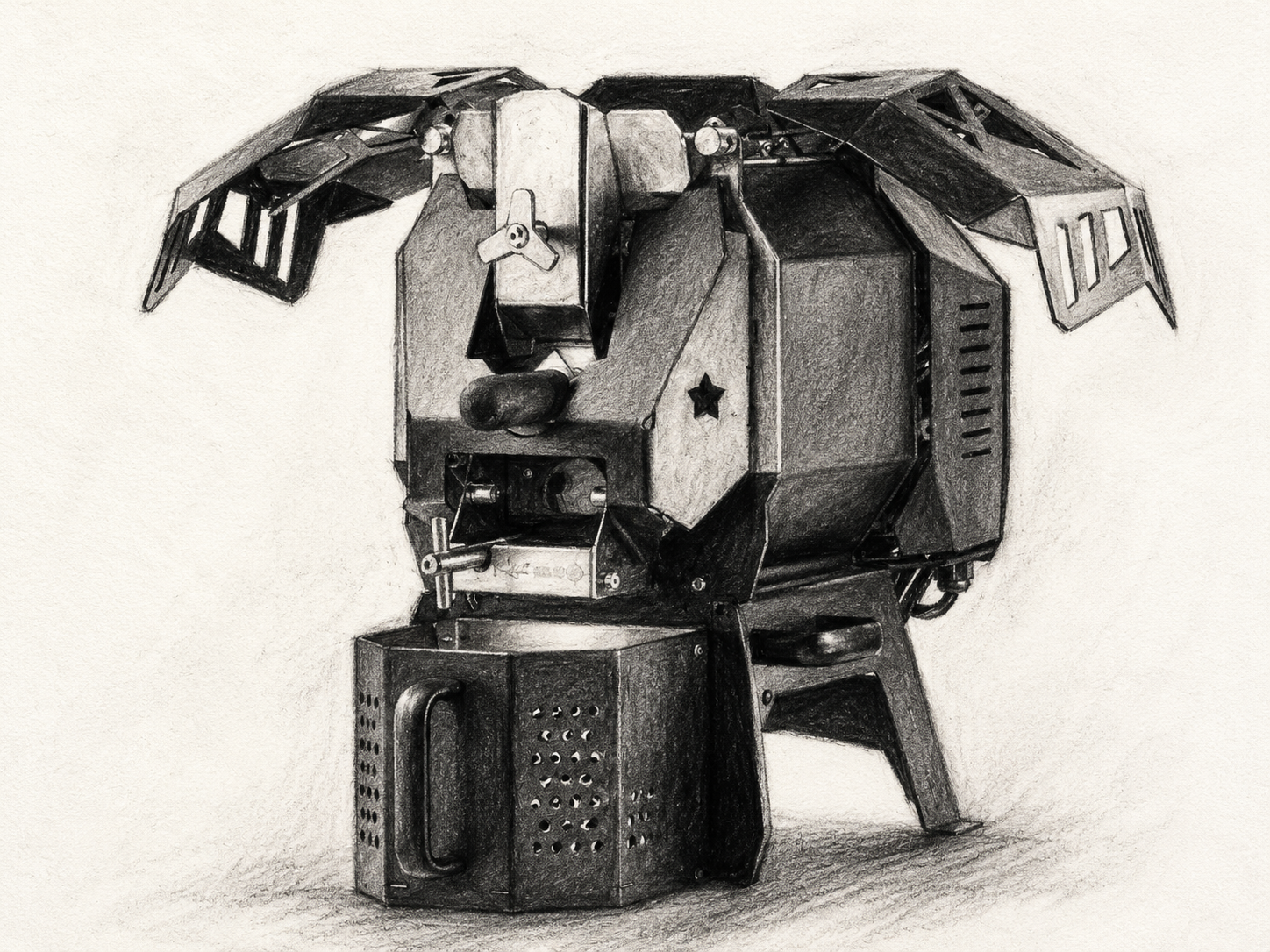
PROJECT STATUS
Ordered — now the learning begins
M2 ordered
After working through the options, I chose the Artisan-focused Kaleido M2 route and placed the order on 3 September 2026. The decision phase is essentially finished; the next meaningful evidence begins when the machine arrives.
Still not first-hand
I have not roasted on it yet. No performance, reliability, usability or cup-quality conclusions are being claimed here. Until I can measure the actual machine, published specifications and other owners’ experiences remain context—not my evidence.
Commission, observe, repeat
The first job will not be chasing the perfect profile. It will be understanding the machine: what the controls actually do, how repeatable it is, what Artisan records, and how those decisions eventually show up in the cup.
WHY THE M2
More visibility, more control, more responsibility
The attraction is not a longer specification sheet. It is the chance to see and change more of what is happening during a roast, while keeping the familiar small-batch scale that suits the way I learn.
A familiar working batch
The M2 was chosen partly because its working range should suit the roughly 250 g batches I already know well. The real test will be establishing where this particular machine feels most stable and repeatable once it arrives.
An open data path
Artisan should provide a clearer record of temperature and control changes. That creates a better route into the Green Bean Ledger and future roast comparisons.
Deliberate experiments
Independent heater, airflow and drum adjustments should make one-variable contrasts possible. The challenge will be changing one thing for a reason—not moving controls simply because they exist.
WHAT CHANGES
A richer view of the roast
- More directly useful temperature information.
- Logged heater, airflow and drum decisions.
- Repeatable profiles that can be compared rather than remembered.
- A stronger connection between machine behaviour, green-coffee information and tasting notes.
WHAT DOES NOT
The cup still has the final word
- More data does not automatically produce better decisions.
- Processing, drying, storage and green-coffee condition still shape the result.
- Weight loss and a tidy curve cannot substitute for tasting.
- The Gene Café work remains a foundation, not a discarded chapter.
BEFORE THE FIRST ROAST
What I want to verify when the M2 arrives
Ordering the machine does not make the research disappear. It changes its job.
Until now I have been trying to understand what I was buying. Once the M2 is physically here, those assumptions can finally be checked against the actual unit rather than retailer descriptions, manuals and other people’s experience.
- Exact machine: confirm the supplied generation, model designation, drum configuration and any differences from the specifications used during purchase research.
- Electrical supply: confirm the delivered unit is correct for 230 V / 50 Hz operation in Ireland, including the supplied plug, rated power and real power behaviour during roasting.
- Artisan connection: establish a clean, repeatable connection and identify exactly which temperature channels and machine controls are exposed.
- Temperature measurement: understand what each probe is actually measuring, how quickly it responds and whether any offsets or calibration checks are sensible before interpreting the curves too confidently.
- Heat, airflow and drum control: confirm the real usable ranges and—more importantly—observe how changes in each control affect the roast rather than assuming the number on screen tells the whole story.
- Ventilation: verify exhaust temperature, smoke behaviour and airflow requirements in the actual roasting room before settling on the final ducting arrangement.
- Cooling: measure how quickly a normal batch can be cooled and how much roast momentum remains after drop.
- Repeatability: run simple baseline roasts before changing multiple controls. One attractive Artisan curve proves very little; repeated machine behaviour is far more useful.
- Practical ownership: understand cleaning, routine maintenance, consumable parts, spares and anything I would rather discover before roast fifty than after it.
This is where specifications start becoming observations. I expect some assumptions to survive and others to be wrong. Both are useful.
LEARNING BEFORE THE FIRST ROAST
Understanding the heat before touching the controls
The M2 gives me more ways to change a roast, which makes understanding the underlying heat flow more important rather than less. Before the machine arrives I have started working through convection, radiation, conduction, evaporation, stored heat and what a temperature probe is actually telling me.
Coffee roasting thermodynamics: a beginner’s attempt to understand what is actually happening
This is a research-led learning note rather than an M2 profile or recipe. It is my attempt to build a simple physical model first, so later changes to heater power, airflow and drum speed have a reason behind them.
THE FIRST TEN ROASTS
A learning plan before chasing profiles
1. Commission safely
Read the supplied instructions, confirm ventilation and electrical requirements, understand emergency stopping and cooling, and check the machine at idle before adding coffee.
2. Establish a simple baseline
Use a known coffee at a familiar batch size. The first aim is to understand responses and controls—not to force the M2 to imitate a Gene Café temperature schedule.
3. Test repeatability
Repeat the baseline before drawing conclusions. A single attractive curve or cup is an observation; repeated behaviour is the beginning of evidence.
4. Change one variable
Explore heat, airflow or drum speed separately where practical. Record the reason, the action, the roast response and the cup result.
5. Close the loop in the cup
Log green and roasted weights, rest the coffee consistently, taste across comparable brews and record what improved—or failed to improve.
THE DATA PATH
From machine signal to useful evidence
Artisan
Captures the roast curve and control decisions, giving each roast a machine-readable history.
Green Bean Ledger
Connects that history to the coffee, batch weights, weight loss, roast identity and later tasting notes.
RoastAid and RoastSignal
May add independent evidence channels over time. Acoustic events will remain described as candidate activity only—not confirmed first crack.
The goal is not to collect the most numbers. It is to preserve enough context to explain what changed, repeat what worked and recognise when a convincing graph produced an ordinary cup.
CONTINUITY
The Gene Café work still matters
The CBR-301 taught me something much more useful than a collection of roast settings. It taught me to work patiently with imperfect information: repeat batches, mark milestones, compare like with like, track weight loss, question first crack, record what the machine actually did and—eventually—drink the coffee before deciding whether any of it mattered.
The M2 should make considerably more of the roasting process visible. Artisan should give me better temperature information and a record of the control decisions I make along the way. But having more data does not automatically mean understanding more.
In fact, I suspect the next challenge may be the opposite of the Gene Café. With the CBR-301 I often wanted more control. With the M2 I may have to learn when not to use the control I now have.
So the project will move through deliberately labelled stages: purchase research completed, arrival and commissioning, first ten roasts, controlled experiments, and eventually repeatable findings.
Failed assumptions belong here as much as successful ones. If something I believed before the machine arrived turns out to be wrong, I would rather leave the correction visible than quietly rewrite the history.